Quick answer
For construction workers, the database supports two distinct exoskeleton types: powered back exoskeletons for lifting and forward bending (Cray X) and passive shoulder exoskeletons for overhead work (Skelex 360, MATE-XT, AIRFRAME). A passive back exosuit (Apex 2) covers bending and lifting at the lowest entry price. No single system in this dataset covers both heavy lifting and sustained overhead work, so the correct choice depends on which task dominates the site.
Key takeaways
- Construction tasks split into two exoskeleton categories: back-assist for lifting and bending, shoulder-assist for overhead work. The database contains no hybrid system that covers both.
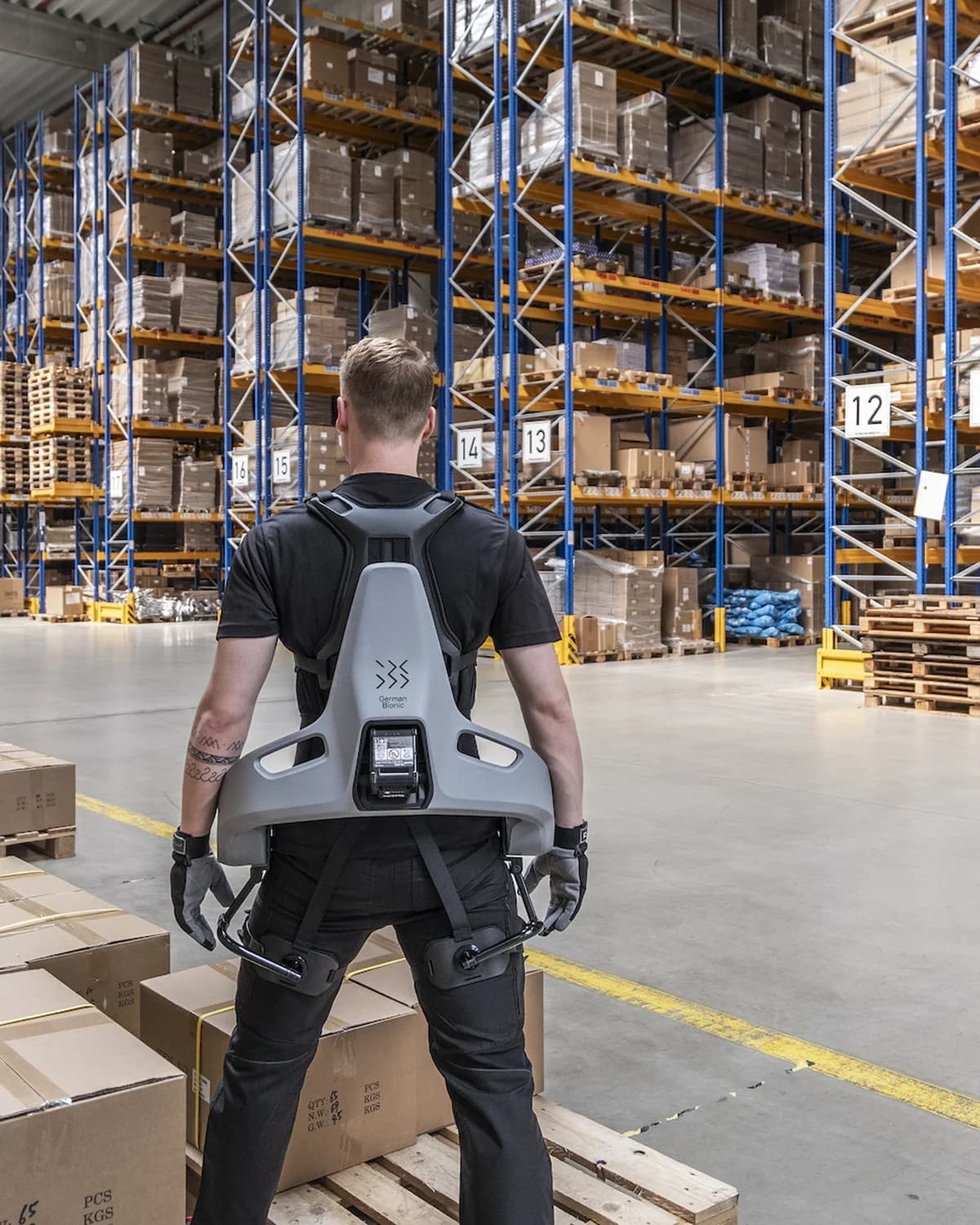
- The only powered option, German Bionic Cray X, costs from $9,900 and weighs 7.6 kg; it is the only system with usage telemetry and a cloud fleet dashboard.
- Passive shoulder systems range from $2,950 (AIRFRAME) to $5,900 (MATE-XT), with assist forces of 60 N to 100 N.
- Warranty is undisclosed for Cray X and MATE-XT, and unknown for AIRFRAME. Only Skelex 360 (24 months) and Apex 2 (12 months) publish a term.
- ISO 13482 is cited for Cray X, Skelex 360 and MATE-XT. Apex 2 and AIRFRAME list CE only, with standards referenced unknown.
What construction work actually demands from an exoskeleton
Construction is not a single repetitive task. A worker may spend the morning tying rebar at waist height, the afternoon installing ceiling ductwork overhead, and the next day carrying formwork. The database reflects this split: every system is either a back exoskeleton or a shoulder exoskeleton, and none claims to do both.
The environmental constraint matters as much as the task. Dust, moisture and impact are routine on site, yet the database does not record ingress protection (IP rating) for any of the five systems. That is a genuine gap for construction procurement, because a system that is not sealed against dust may not survive a full project. Buyers should treat IP rating as a required disclosure before any pilot.
Weight and wear time also interact with construction reality. The Cray X weighs 7.6 kg, which is heavy for a powered system but includes motors, battery and frame. The passive shoulder systems are far lighter: Skelex 360 at 1.6 kg, AIRFRAME at 1.5 kg, MATE-XT at 4.2 kg. Apex 2, a soft exosuit, is the lightest at 1.2 kg. For workers who climb ladders or move through tight spaces, the lighter passive systems have an obvious practical advantage, though the database does not record maximum walking speed or stair/slope capability for any system (stated as not applicable).
Comparison table: five systems for construction buyers
| System | Maker | Drive | Weight | Assist force | Lift support | Price from (USD) | Certifications | Warranty |
|---|
| Cray X | German Bionic | Active | 7.6 kg | 300 N | 30 kg | 9,900 | CE, ISO 13482 | Undisclosed |
| Skelex 360 | Skelex | Passive | 1.6 kg | 70 N | 5 kg | 4,900 | CE | 24 months |
| MATE-XT | Comau | Passive | 4.2 kg | 100 N | 5 kg | 5,900 | CE, ISO 13482 | Undisclosed |
| Apex 2 | HeroWear | Passive | 1.2 kg | 220 N | 20 kg | 1,195 | CE | 12 months |
| AIRFRAME | Levitate Technologies | Passive | 1.5 kg | 60 N | 5 kg | 2,950 | CE | Unknown |
All prices are indicative list prices from the database; fleet pricing and service contracts are negotiated. The table omits battery runtime and connectivity for passive systems because those parameters are not applicable.
Back-assist systems: Cray X vs Apex 2
If the dominant construction task is lifting and forward bending, the database offers two back-assist options at opposite ends of the market. The Cray X is the only powered system: 300 N assist force, 30 kg lift support, 8-hour hot-swappable battery, and a cloud fleet dashboard via the Cray Visor app. It is also the only system in the dataset with usage telemetry, which matters for contractors who need to demonstrate utilization across a fleet. At $9,900 list, it is roughly eight times the price of the Apex 2.
The Apex 2 is a passive exosuit at $1,195, weighing 1.2 kg, with 220 N assist force and 20 kg lift support. It has no battery, no sensors and no connectivity. For a construction firm testing exoskeletons on a single crew, the Apex 2 is the lowest-risk entry: low capital, 12-month warranty, and 2–4 week lead time. The trade-off is that it provides no data on usage and no active adaptation to the load.
The Cray X’s 6–10 week lead time and 7.6 kg weight are real deployment constraints. A powered system also introduces battery management into the site routine: charging, swapping and storage. The database lists battery life at 8 hours and charge time at 2 hours, with hot-swappable batteries, so a two-battery rotation can cover a shift. But the total cost of ownership includes spare batteries, which are not priced in the database.
Shoulder-assist systems: three passive options for overhead work
Overhead work is common in construction: ceiling grid, ductwork, electrical conduit, façade work. Three passive shoulder exoskeletons are listed. The MATE-XT from Comau has the highest assist force at 100 N and the highest price at $5,900, but also the highest weight at 4.2 kg. The Skelex 360 offers 70 N at 1.6 kg for $4,900, with a 24-month warranty. The AIRFRAME from Levitate Technologies is the lightest at 1.5 kg and the cheapest at $2,950, but with the lowest assist force at 60 N and no disclosed warranty or standards.
The choice hinges on the assist force needed for the task. A worker holding a heavy tool overhead for minutes at a time may need the MATE-XT’s 100 N. A worker doing lighter, more repetitive overhead tasks may prefer the lighter Skelex 360 or AIRFRAME to reduce fatigue from the device itself. The database does not record wear-time limits or subjective comfort, so those must be assessed in a site trial.
Certification is a differentiator. Skelex 360 and MATE-XT both cite ISO 13482, the standard for personal care robots, which is increasingly requested in European procurement. AIRFRAME lists CE only, with standards referenced unknown. For a construction buyer with a formal safety case, that missing standard reference is a documentation gap.
What the datasheet doesn't tell you
Several parameters that matter on a construction site are missing from the database. Each is a question to put to the maker before purchase.
- IP rating (ingress protection): Not recorded for any of the five systems. Construction sites are dusty and often wet. Without an IP rating, a buyer cannot judge whether a system will survive a project or need frequent repair. This is the single most important unknown for construction.
- Warranty: Undisclosed for Cray X and MATE-XT, unknown for AIRFRAME. Only Skelex 360 (24 months) and Apex 2 (12 months) publish a term. Warranty length directly affects the total cost of ownership and the risk of a fleet purchase.
- Standards referenced: Unknown for Apex 2 and AIRFRAME. CE marking alone does not show which harmonized standards were applied. For a safety file, the buyer needs the standard list.
- Battery cost and replacement interval: Not in the database for Cray X. The 8-hour battery life and 2-hour charge time are given, but the price of a replacement battery and its expected cycle life are not. For a powered fleet, battery replacement can be a significant recurring cost.
- Maximum walking speed and stair/slope capability: Stated as not applicable for all systems. In practice, construction workers move across uneven ground and stairs. The database cannot confirm whether any system is rated for those conditions, so the buyer must ask.
These gaps are not trivial. A construction exoskeleton that fails on dust ingress or lacks a warranty may cost more in downtime than it saves in ergonomic benefit. The database’s completeness scores (Cray X 96, Skelex 360 95, MATE-XT 94, Apex 2 94, AIRFRAME 84) reflect how much is known, not how well a system performs on site.
Who should not choose this
Do not choose a passive shoulder exoskeleton if your primary construction task is heavy lifting from the ground. The shoulder systems (Skelex 360, MATE-XT, AIRFRAME) provide 5 kg lift support and are designed for sustained arm elevation, not for lifting 20–30 kg loads. Using them for lifting would be a misapplication.
Do not choose the Cray X if you need a system for overhead work. It is a back exoskeleton with 2 degrees of freedom for lifting and forward bending; it does not support the arms. A crew doing ceiling work needs a shoulder system.
Do not choose the AIRFRAME if you require a documented warranty or a cited ISO standard. Both are unknown in the database, which is a problem for formal procurement. Similarly, avoid the MATE-XT if weight is a primary concern: at 4.2 kg it is more than twice the weight of the Skelex 360 and nearly three times the AIRFRAME.
Finally, do not buy any of these systems for construction without first obtaining an IP rating from the maker. The database does not supply it, and a system that is not sealed against dust may not last a season.
Procurement next step
Start by defining the dominant task on your site: lifting/bending or overhead work. Then request the missing parameters from the maker. For a back-assist pilot, compare the Cray X and Apex 2 side by side on our comparison tool. For overhead work, compare the Skelex 360 and MATE-XT. If you need help framing the request for IP rating, warranty and battery cost, contact our selection desk. You can also browse the full industrial exoskeleton category for other systems.
FAQ
Can a construction worker use a passive exoskeleton for both lifting and overhead work?
No. The database separates back-assist systems (Cray X, Apex 2) from shoulder-assist systems (Skelex 360, MATE-XT, AIRFRAME). No system in the dataset is documented for both task types.
Which exoskeleton for construction has the highest assist force?
The Cray X has the highest assist force at 300 N and 30 kg lift support. Among passive systems, the Apex 2 has 220 N and 20 kg lift support, but it is a back exosuit, not a shoulder system.
Is ISO 13482 required for construction exoskeletons?
The database does not state a legal requirement. However, Cray X, Skelex 360 and MATE-XT cite ISO 13482, while Apex 2 and AIRFRAME list CE only with standards referenced unknown. Buyers with a formal safety case should request the standard list.
Sources: German Bionic official site (germanbionic.com); Comau MATE-XT product page (comau.com); HeroWear Apex 2 page (herowearexo.com); Skelex official site (skelex.com); Levitate Technologies official site (levitatetech.com).
 ExoSelect research