Quick answer
For stroke rehabilitation, a powered lower-limb exoskeleton is a therapist-supervised gait-training device. The main commercial options in this database are EksoNR (Ekso Bionics), HAL Lower Limb (Cyberdyne), Indego (Parker Hannifin), Atalante X (Wandercraft) and ExoMotus M4 (Fourier Intelligence). Selection hinges on patient envelope, therapist workflow, certification and published clinical evidence, not on headline speed.
This guide is written for procurement and engineering teams evaluating exoskeletons for stroke rehabilitation. It uses only the specifications disclosed in the ExoSelect database. Where a parameter is missing, we state that it is not disclosed. No price, certification or clinical claim is inferred.
Key takeaways
- All five systems are active or hybrid lower-limb exoskeletons intended for therapist-supervised gait training; none is a consumer device.
- Patient height ranges cluster between 145 cm and 195 cm, but user weight limits differ from 100 kg to 113 kg.
- Certification sets differ: EksoNR and Indego carry FDA and CE; HAL Lower Limb carries CE medical and ISO 13485; Atalante X carries CE medical; ExoMotus M4 carries NMPA and CE.
- Battery life is 3–4 h across the set, with charge times of 2–3 h; all list swappable batteries.
- Clinical evidence is described as published studies in stroke and related neurorehabilitation, but the database does not quantify outcomes.
- Price is not disclosed for any system; availability is on inquiry or via a treatment programme.
What a stroke rehabilitation exoskeleton actually is
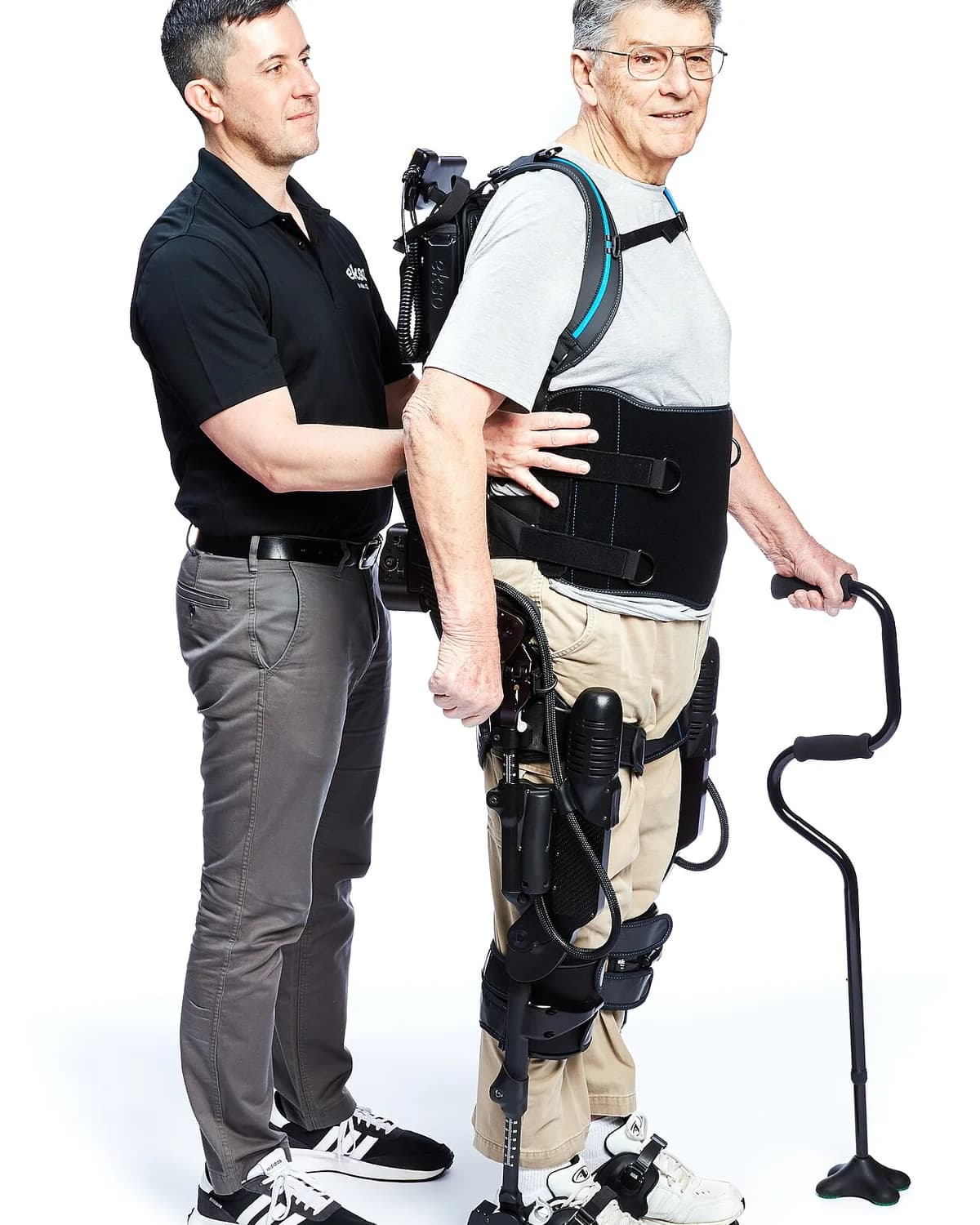
In this database, a stroke rehabilitation exoskeleton is a powered or hybrid lower-limb device that supports hip and knee movement during therapist-supervised gait training. EksoNR is described as a therapist-supervised gait exoskeleton for inpatient and outpatient neurorehabilitation. HAL Lower Limb is a cybernetic assistive limb that reads bioelectric signals. Indego is a modular lower-limb exoskeleton for clinical gait training and personal mobility. Atalante X is a self-balancing robotic exoskeleton for overground gait rehabilitation. ExoMotus M4 is a powered lower-limb exoskeleton for repeatable clinical gait training.
These are clinical capital or programme assets, not consumer wearables. Procurement therefore involves clinical engineering, rehabilitation therapy leadership and, often, research governance. For a broader category view, see the medical exoskeleton category page.
Comparison table: disclosed specifications
The table below uses only database values. Blank cells indicate data not disclosed.
| System | Maker | Drive | Weight | Height range | User weight | Speed | DOF | Battery life | Charge time | Certifications |
|---|
| EksoNR | Ekso Bionics | Active | 23.6 kg | 152–193 cm | 100 kg | 1.1 km/h | 4 | 4 h | 2.5 h | FDA, CE |
| HAL Lower Limb | Cyberdyne | Hybrid | 17 kg | 145–190 cm | 100 kg | 1.5 km/h | 2 | 3 h | 2 h | CE medical, ISO 13485 |
| Indego | Parker Hannifin | Active | 12.3 kg | 155–195 cm | 113 kg | 2 km/h | 4 | 4 h | 2.5 h | FDA, CE |
| Atalante X | Wandercraft | Active | 65 kg | 145–190 cm | 100 kg | 2.5 km/h | 12 | 4 h | 3 h | CE medical |
| ExoMotus M4 | Fourier Intelligence | Active | 23.5 kg | 155–190 cm | 100 kg | 1.2 km/h | 4 | 3 h | 2 h | NMPA, CE |
Assist torque is disclosed at 40 Nm for EksoNR and HAL Lower Limb; it is not disclosed for Indego, Atalante X or ExoMotus M4. Atalante X lists 80 kg lift support. Materials vary: aluminium alloy and carbon fibre for EksoNR; aluminium alloy and engineering polymers for HAL Lower Limb; carbon fibre and aluminium for Indego; aluminium and carbon fibre for Atalante X; aluminium alloy for ExoMotus M4.
Patient envelope and clinical fit
Height range and user weight are the first procurement filters. Indego has the widest disclosed height range at 155–195 cm and the highest user weight at 113 kg. EksoNR covers 152–193 cm at 100 kg. HAL Lower Limb and Atalante X cover 145–190 cm at 100 kg. ExoMotus M4 covers 155–190 cm at 100 kg.
Speed is a workflow parameter, not a rehabilitation outcome. Disclosed values range from 1.1 km/h (EksoNR) to 2.5 km/h (Atalante X). Degrees of freedom differ sharply: HAL Lower Limb lists 2 DOF, EksoNR, Indego and ExoMotus M4 list 4 DOF, and Atalante X lists 12 DOF. Higher DOF does not automatically mean better stroke rehabilitation; it changes the training task and the therapist's control burden.
Climbing capability is limited across the set. EksoNR supports level ground and ramps, with stair training not supported. Indego supports sit-to-stand and level walking, with clinical assessment required for stairs. Atalante X supports level ground and slopes, with stairs not supported. HAL Lower Limb and ExoMotus M4 list level walking with clinical assessment required. Buyers should map these limits to the actual therapy environment.
Control, sensing and data workflow
Control modes reflect different engineering philosophies. EksoNR offers therapist-adjusted variable assistance, sit-to-stand and step initiation. HAL Lower Limb offers bioelectric signal control and an autonomous gait mode. Indego offers intuitive movement and therapist-controlled gait. Atalante X offers self-balancing walk and therapist-guided movement. ExoMotus M4 offers therapist-controlled and assisted gait.
Sensors are disclosed as joint encoders, force sensors and inertial measurement units for EksoNR; bioelectric signal sensors, joint angle sensors and force sensors for HAL Lower Limb; joint position and force sensors for Indego; force plates, joint encoders and IMU for Atalante X; joint encoders and force sensors for ExoMotus M4.
Connectivity is clinically relevant for audit and research. EksoNR lists EksoPulse clinical software and session data export. HAL Lower Limb lists treatment data logging. Indego lists Bluetooth and session data logging. Atalante X lists a clinical dashboard. ExoMotus M4 lists training data export. Buyers should confirm data residency and export formats during technical due diligence; the database does not disclose these details.
Certification, standards and evidence
Certification is a hard procurement gate. EksoNR lists FDA and CE, with IEC 60601-1 and IEC 60601-1-2. HAL Lower Limb lists CE medical and ISO 13485, with IEC 60601-1 and ISO 13485. Indego lists FDA and CE, with IEC 60601-1. Atalante X lists CE medical, with IEC 60601-1 and ISO 13482. ExoMotus M4 lists NMPA and CE, with IEC 60601-1.
Clinical evidence is described qualitatively. EksoNR cites published stroke and spinal cord injury rehabilitation studies. HAL Lower Limb cites clinical studies in stroke, SCI and neuromuscular conditions. Indego cites peer-reviewed gait training studies. Atalante X cites clinical studies in neurological rehabilitation. ExoMotus M4 cites clinical rehabilitation studies in China. The database does not disclose effect sizes, trial registrations or patient counts, so those must be requested from makers.
Warranty is listed as 12 months for all five systems. Lead time is 8–12 weeks for EksoNR; programme-dependent for HAL Lower Limb; contact regional distributor for Indego and ExoMotus M4; contact maker for Atalante X. Regions differ: EksoNR covers North America, Europe and Asia-Pacific; HAL Lower Limb covers Japan, Europe and Asia-Pacific; Indego covers North America and Europe; Atalante X covers Europe and North America; ExoMotus M4 covers Asia-Pacific, Europe and the Middle East.
Procurement checklist for stroke rehabilitation
- Confirm the patient height and weight envelope against your referral population; do not assume the widest range is clinically necessary.
- Verify the certification pathway required in your jurisdiction; FDA and CE are not interchangeable with NMPA.
- Ask for the full clinical evidence package, including stroke-specific study design and endpoints, because the database only confirms that studies are published.
- Check therapist control modes and data export against your documentation and research requirements.
- Model battery swap and charge logistics: disclosed battery life is 3–4 h and charge time is 2–3 h.
- Request total cost of ownership, including training, service and consumables; price is not disclosed in this database.
For side-by-side specification review, use the ExoSelect comparison tool. To discuss availability and configuration, submit an inquiry.
Product pages
Review the individual records for EksoNR, HAL Lower Limb, Indego, Atalante X and ExoMotus M4.
FAQ
Which exoskeleton is most suitable for stroke rehabilitation?
There is no single answer from disclosed data. All five systems are intended for therapist-supervised gait training, and clinical evidence is described qualitatively. Selection depends on patient envelope, certification and therapist workflow.
Do these exoskeletons have FDA clearance?
EksoNR and Indego list FDA and CE. HAL Lower Limb lists CE medical and ISO 13485. Atalante X lists CE medical. ExoMotus M4 lists NMPA and CE. Buyers should confirm the exact indication and jurisdiction with the maker.
What is the price of a stroke rehabilitation exoskeleton?
Price is not disclosed for any system in this database. Availability is listed as on inquiry or via a treatment programme, so commercial terms must be requested directly from the maker or distributor.
 ExoSelect research