Quick answer: For upper-limb assist, the main procurement decision is between passive shoulder exoskeletons (Skelex 360, MATE-XT, AIRFRAME) and active systems like Cray X, which assist the back rather than the shoulder. Passive units cost less and need no battery, but their assist force, weight and warranty vary widely—and key parameters like warranty for MATE-XT and standards for AIRFRAME are not disclosed in the database.
Upper-limb assist exoskeletons are passive or active devices that support the shoulder and arm during overhead or repetitive work. This FAQ answers the procurement questions buyers actually ask: which systems exist, what they cost, what the datasheets omit, and when an upper-limb exoskeleton is the wrong choice.
Key takeaways
- Passive shoulder exoskeletons range from 1.5 kg (AIRFRAME) to 4.2 kg (MATE-XT) and from 2,950 USD to 5,900 USD indicative list price.
- Assist force varies from 60 N (AIRFRAME) to 100 N (MATE-XT); Skelex 360 sits at 70 N.
- Warranty is 24 months for Skelex 360, 12 months for Apex 2, and undisclosed for MATE-XT and AIRFRAME.
- Only Cray X is active and connected, but it assists the back—not the upper limb—so it is not a like-for-like alternative.
- All four systems carry CE marking; ISO 13482 is cited for Cray X, Skelex 360 and MATE-XT, but not stated for AIRFRAME.
Which upper-limb assist exoskeletons are in the database?
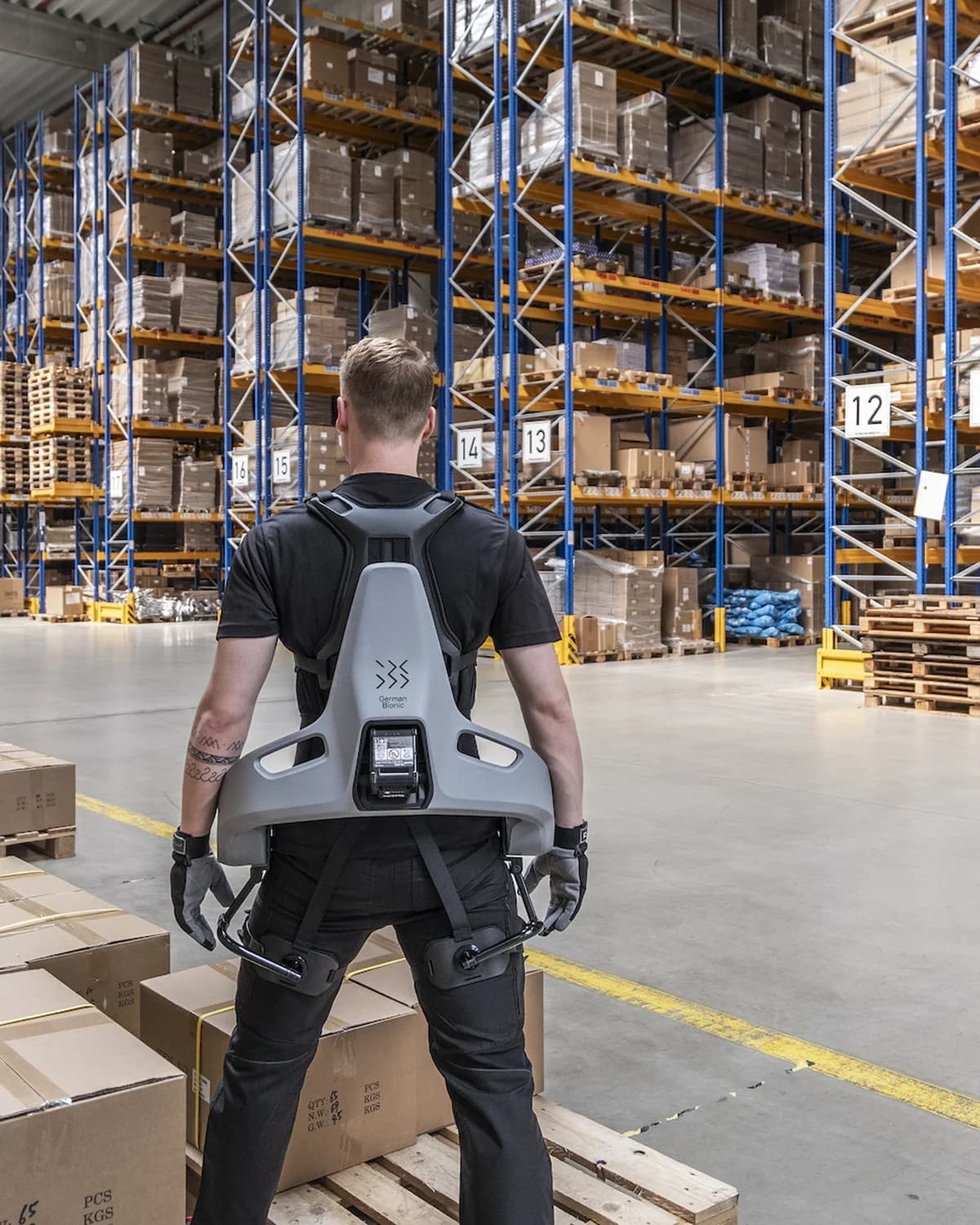
The ExoSelect database lists three passive upper-limb exoskeletons: Skelex 360 by Skelex, MATE-XT by Comau, and AIRFRAME by Levitate Technologies. A fourth system, Cray X by German Bionic, is an active back exoskeleton and is included here only as a contrast because buyers sometimes confuse upper-limb and back-assist categories.
All three upper-limb units are passive: they use springs or mechanical structures to support the arm against gravity. None has sensors, connectivity or a battery. That makes them simpler to deploy but also means their assistance profile is fixed by mechanical design, not software.
Comparison table: passive upper-limb systems
| Spec | Skelex 360 | MATE-XT | AIRFRAME |
|---|
| Maker | Skelex | Comau | Levitate Technologies |
| Drive | Passive | Passive | Passive |
| Weight | 1.6 kg | 4.2 kg | 1.5 kg |
| Assist force | 70 N | 100 N | 60 N |
| Assist torque | 12 Nm | 15 Nm | 10 Nm |
| Lift support | 5 kg | 5 kg | 5 kg |
| Height range | 160–195 cm | 155–195 cm | 157–198 cm |
| User weight | 110 kg | 100 kg | 113 kg |
| Price from (USD) | 4,900 | 5,900 | 2,950 |
| Warranty | 24 months | Undisclosed | Unknown |
| Certifications | CE | CE, ISO 13482 | CE |
| Standards | ISO 13482 | ISO 13482 | Unknown |
| Lead time | Contact maker | 4–8 weeks | Contact maker |
| Regions | Europe, North America | Europe, North America, Asia-Pacific | North America |
Source: ExoSelect database, indicative list prices; final quotes depend on configuration and volume.
What does an upper-limb exoskeleton cost?
Indicative list prices in the database range from 2,950 USD for AIRFRAME to 5,900 USD for MATE-XT. Skelex 360 sits at 4,900 USD. These are not transaction prices: the database notes that final quotes depend on configuration, training and quantity. For a fleet rollout, expect per-unit costs to differ from list, and budget separately for fitting, training and replacement parts.
Passive upper-limb systems avoid battery and charging infrastructure, so total cost of ownership is dominated by purchase price, fitting time and warranty coverage. That makes the undisclosed warranty on MATE-XT and AIRFRAME a material gap: a 24-month warranty on Skelex 360 versus an unknown term on the other two changes the three-year cost calculation.
How do assist force and weight trade off?
MATE-XT delivers the highest assist force in the group at 100 N, but it also weighs 4.2 kg—more than twice the 1.6 kg of Skelex 360 and nearly three times the 1.5 kg of AIRFRAME. For sustained overhead work, device weight sits on the shoulders and torso all shift, so a heavier unit can offset some of its assistance benefit. AIRFRAME is the lightest at 1.5 kg but provides the lowest assist force at 60 N.
There is no universal correct balance. The database does not provide fatigue data, wear-time limits or task-specific performance, so buyers must map assist force and weight to their own task duration and posture. A 100 N unit may suit short, heavy overhead tasks; a 1.5 kg unit may suit long shifts at lower load.
What the datasheet doesn't tell you
Several parameters that matter for procurement are missing or unverified in the database:
- Warranty for MATE-XT (undisclosed) and AIRFRAME (unknown). Warranty length directly affects maintenance budgeting and fleet replacement cycles. Without it, you cannot compare three-year cost of ownership against Skelex 360's 24 months.
- Standards referenced for AIRFRAME (unknown). AIRFRAME carries CE marking, but the database does not state which standards it references. If your procurement policy requires ISO 13482 or an equivalent, you must request the declaration of conformity.
- Clinical evidence for Skelex 360 (unknown) and AIRFRAME (unknown). The database records no clinical evidence for either. That does not mean none exists, but it means you cannot rely on the database to support an ergonomic claim; ask the maker for study references.
- Lead time for Skelex 360 and AIRFRAME (contact maker). Only MATE-XT has a stated lead time (4–8 weeks). For project planning, the other two require a direct quote.
These gaps are not trivial. A buyer comparing on price alone would see AIRFRAME as the cheapest option, but without warranty or standards information the risk-adjusted cost is unknown.
Who should not choose this
Do not choose a passive upper-limb exoskeleton if your task is primarily lifting from the floor or forward bending at the waist. Those tasks are addressed by back exoskeletons such as Cray X or Apex 2, not by shoulder-support devices. The three upper-limb units here assist arm elevation; they do not provide hip or back extension assistance.
Also avoid MATE-XT if your procurement requires a disclosed warranty term before purchase, and avoid AIRFRAME if your compliance team requires a stated standards reference beyond CE. In both cases, the database does not contain the information you need to sign off, so you must obtain it from the maker or choose Skelex 360, which has both warranty and ISO 13482 stated.
How to compare upper-limb exoskeletons
Use the ExoSelect compare tool to line up Skelex 360, MATE-XT and AIRFRAME side by side. The industrial exoskeleton category page lists all systems in this segment. For a formal quote or a selection discussion, contact the ExoSelect selection desk.
FAQ
What is the difference between upper-limb and back exoskeletons?
Upper-limb exoskeletons support the shoulder and arm during overhead work; back exoskeletons assist hip extension during bending and lifting. They are not interchangeable. Cray X and Apex 2 are back-assist systems, while Skelex 360, MATE-XT and AIRFRAME are upper-limb systems.
Do upper-limb exoskeletons need batteries?
No. All three upper-limb systems in the database are passive and have no battery, sensors or connectivity. Cray X is the only active system listed here, and it is a back exoskeleton.
Which upper-limb exoskeleton has the longest warranty?
Skelex 360 has a stated 24-month warranty. MATE-XT's warranty is undisclosed and AIRFRAME's is unknown in the database. Apex 2, a back exosuit, has 12 months.
Next step
Request the declaration of conformity and warranty terms for MATE-XT and AIRFRAME from their makers, or compare Skelex 360 against both using the ExoSelect compare tool. If you need a documented parameter that is missing here, ask the selection desk.
 ExoSelect research