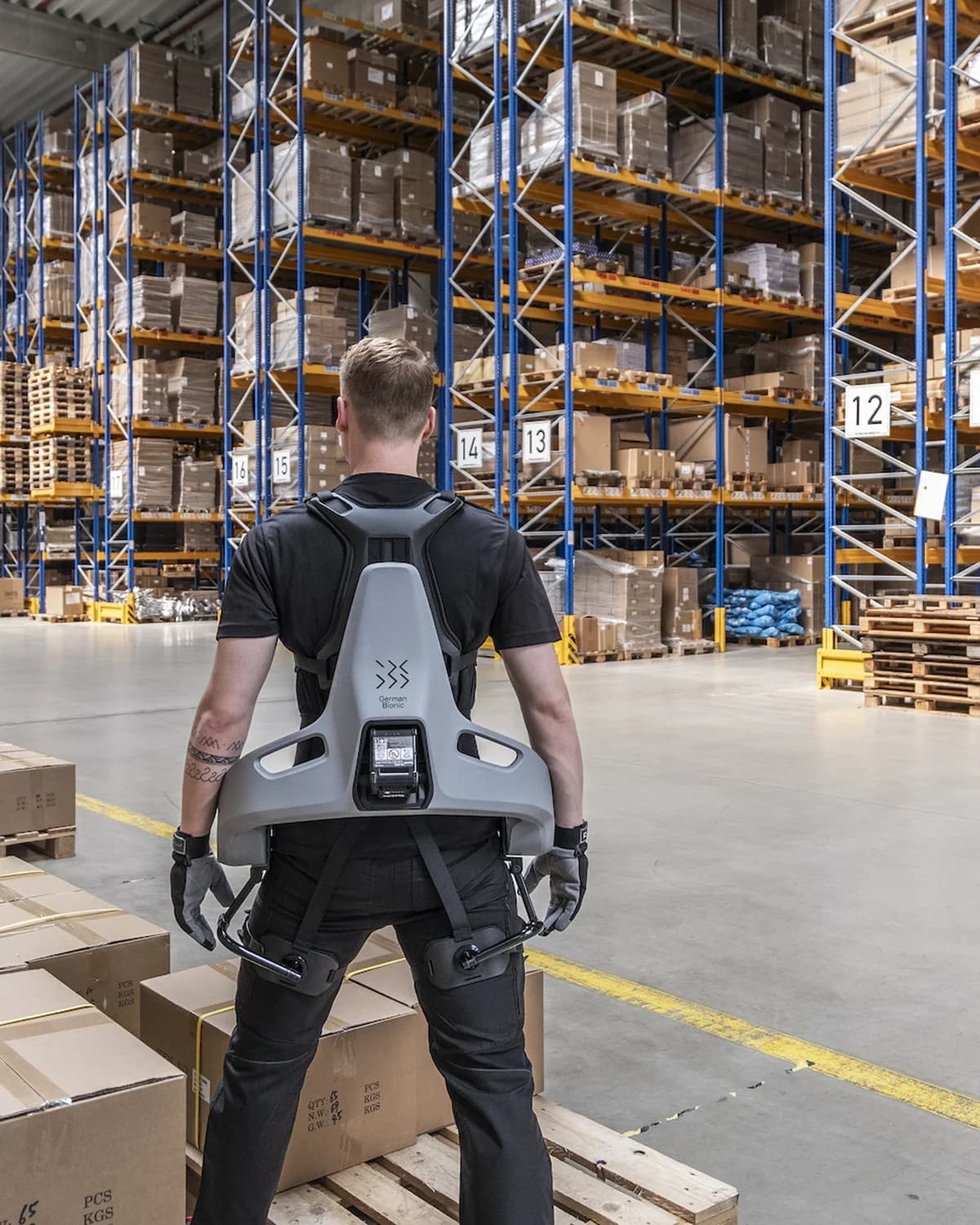
Quick answer: For warehousing in Europe, the only logistics exoskeleton in the ExoSelect database with stated European availability is the Verve Motion SafeBoost, an active soft exosuit offered via subscription. The passive H-WULF (ULS Robotics) and active CLOi SuitBot (LG Electronics) are listed for Asia-Pacific only, so European buyers must treat them as out-of-region unless the maker confirms otherwise in writing.
Key takeaways
- Only SafeBoost lists Europe in its regions; H-WULF and CLOi SuitBot list Asia-Pacific only.
- SafeBoost is subscription-only; no public price, no peak assist torque, no clinical evidence.
- H-WULF has an indicative price of 3,600 USD but no disclosed assist force, torque, warranty, lead time, or standards.
- CLOi SuitBot has no disclosed certifications, height range, connectivity, warranty, or price, and only limited availability.
- CE marking is not the same as ISO 13482 compliance; only SafeBoost references ISO 13482.
Why Europe is a different procurement problem
European warehouse operators face a compliance stack that US or Asian buyers often do not: machinery directive conformity, CE marking, and increasingly ISO 13482 for personal care robots. The database shows only SafeBoost declares CE and references ISO 13482. H-WULF declares CE but its standards field is unknown. CLOi SuitBot has no disclosed certifications at all. That asymmetry matters more than any assist-force number, because a device without documented conformity cannot be deployed on a European site without the buyer carrying the regulatory risk.
The regional availability field is equally blunt. SafeBoost lists North America and Europe. H-WULF lists Asia-Pacific. CLOi SuitBot lists Asia-Pacific. A European buyer who shortlists all three is comparing one in-region product against two out-of-region products with unknown service, spare-parts, and warranty pathways. That is not a like-for-like comparison, and any total-cost model that ignores it is misleading.
Comparison table: supplied specifications only
| Parameter | SafeBoost (Verve Motion) | H-WULF (ULS Robotics) | CLOi SuitBot (LG Electronics) |
|---|
| Drive | Active | Passive | Active |
| Weight | 2.2 kg | 3.8 kg | 5.5 kg |
| Lift support | 15 kg | 30 kg | 30 kg |
| Assist force | 80 N | Unknown | Unknown |
| Assist torque | Unknown | Unknown | 25 Nm |
| Battery life | 8 h | Not applicable | 4 h |
| Charge time | 2 h | Not applicable | 2 h |
| Swappable battery | Yes | Not applicable | Yes |
| User height range | 155–195 cm | 160–190 cm | Unknown |
| User weight limit | 115 kg | 100 kg | 100 kg |
| Certifications | CE | CE | Unknown |
| Standards referenced | ISO 13482 | Unknown | Unknown |
| Connectivity | Cloud dashboard, fleet telemetry, Bluetooth | Not applicable | Unknown |
| Price | Undisclosed (subscription) | 3,600 USD indicative | Undisclosed |
| Regions | North America, Europe | Asia-Pacific | Asia-Pacific |
| Availability | Subscription programme | Available on inquiry | Limited availability |
Source: ExoSelect database records for SafeBoost, H-WULF, and CLOi SuitBot. Manufacturer pages: Verve Motion, ULS Robotics, LG Electronics.
What the datasheet doesn't tell you
Peak assist torque for SafeBoost is unknown. Assist force is listed as 80 N, but without torque and the lever arm it acts over, a buyer cannot compare it to CLOi SuitBot's 25 Nm or to any passive system. This is the single most important missing number for matching a device to a lift task.
Clinical evidence for SafeBoost is unknown. For a subscription programme, the buyer is paying for outcomes. Without disclosed clinical or biomechanical evidence, the business case rests on vendor claims, not documented results.
H-WULF's assist force, torque, warranty, lead time, and standards are all unknown. The 3,600 USD indicative price is the only commercial anchor, and it is quoted in USD for an Asia-Pacific product. European buyers cannot build a total-cost model on that alone.
CLOi SuitBot's certifications, height range, connectivity, warranty, and price are unknown. The 25 Nm torque and 1.5 km/h speed are documented, but without certifications the device cannot be assessed for European deployment.
SafeBoost's price is undisclosed. A subscription programme with no public rate card makes budget approval harder, not easier, because the buyer cannot benchmark against a capital purchase.
The compliance gap a top-10 list would miss
Most European warehouse exoskeleton guides treat CE marking as a checkbox. In this dataset, only SafeBoost pairs CE with a referenced standard, ISO 13482. H-WULF declares CE but its standards field is unknown, which means a buyer cannot tell whether the CE mark covers the exoskeleton as machinery, as a personal care robot, or something else. CLOi SuitBot discloses no certification at all. For a procurement team, that is the difference between a device that can be deployed with a documented conformity file and one that shifts regulatory burden onto the site.
The regional field compounds this. A product listed for Asia-Pacific may still be purchasable in Europe, but the database does not confirm European service, spare parts, or warranty. Buyers should not assume a global maker supports a European fleet just because the brand is known.
Who should not choose this
Do not choose H-WULF or CLOi SuitBot for a European warehouse deployment on the basis of this database. Both are listed for Asia-Pacific only, and neither discloses the European compliance, service, or warranty information a site needs. If a European operator wants a passive waist-assist device, H-WULF's 30 kg lift support and 3.8 kg weight are attractive on paper, but the missing standards, warranty, and lead time make it a research item, not a procurement decision.
Do not choose SafeBoost if your procurement process requires a capital purchase with a fixed price and a documented peak torque. The subscription model and the unknown torque and clinical evidence mean it suits buyers who can accept a programme contract and who will demand those parameters in writing before signing. Buyers who need a passive, battery-free device should not shortlist SafeBoost at all, because it is active and depends on an 8 h battery with a 2 h charge time.
Total cost of ownership: what the data supports
The database does not supply enough numbers to build a full TCO model for any of the three systems. SafeBoost has no price and no warranty beyond 12 months. H-WULF has an indicative 3,600 USD price but unknown warranty and lead time. CLOi SuitBot has no price, unknown warranty, and limited availability. Any TCO figure published elsewhere for these devices should be treated as an estimate, not a sourced number. The only defensible statement is that SafeBoost's subscription structure converts capital cost into recurring cost, which changes the approval route inside a European organisation but not the underlying economics, which remain undisclosed.
FAQ
Is there a European-made warehouse exoskeleton in the database?
The database does not identify any of the three logistics systems as European-made. SafeBoost is from Verve Motion and lists Europe as a sales region; H-WULF and CLOi SuitBot list Asia-Pacific.
Does CE marking mean a warehouse exoskeleton is safe to deploy in Europe?
No. CE marking is a declaration, not a test report. Only SafeBoost also references ISO 13482 in the database; H-WULF's standards are unknown and CLOi SuitBot's certifications are unknown.
Can I buy H-WULF in Europe?
The database lists H-WULF's region as Asia-Pacific and its availability as available on inquiry. European availability, service, and warranty are not disclosed, so a buyer must confirm them directly with ULS Robotics.
Next step
Before any trial, request the missing parameters in writing from each maker: peak assist torque and clinical evidence for SafeBoost, assist force and standards for H-WULF, and certifications and height range for CLOi SuitBot. Then compare the documented responses side by side using our comparison tool, or contact the ExoSelect selection desk for a provenance-checked shortlist. For the full logistics category, see logistics exoskeletons.
 ExoSelect research