Quick answer
Industrial exoskeleton certification requirements are not a single licence: in the EU, a powered exoskeleton is typically placed on the market under the Machinery Directive/Regulation route with CE marking, while ISO 13482 is the reference standard for personal care robots and is often cited voluntarily. In the supplied database, German Bionic Cray X and Comau MATE-XT declare both CE and ISO 13482; Skelex 360, HeroWear Apex 2 and Levitate Technologies AIRFRAME declare CE only, and only Cray X additionally lists EN 614-1.
For procurement and engineering teams, the practical question is not whether a device is “certified” in the abstract but which conformity route the maker has taken, which standards are declared on the datasheet, and which parameters — notified body involvement, EMC, functional safety, battery transport classification — are simply not disclosed. The comparison below uses only the specifications supplied in the ExoSelect database and flags every gap rather than filling it.
Key takeaways
- CE marking is declared for all five systems in the database; ISO 13482 is declared for German Bionic Cray X and Comau MATE-XT only.
- EN 614-1 (ergonomic design principles) appears only on Cray X, the sole active, sensor-equipped system in the set.
- No entry discloses a notified body number, an EU-type examination certificate, an EMC report or a functional safety integrity level — treat these as unknown until the maker provides them.
- Passive systems (Skelex 360, MATE-XT, Apex 2, AIRFRAME) declare no sensors, which simplifies the electrical safety file but does not remove machinery conformity obligations.
- Price ranges from 1,195 USD (Apex 2) to 9,900 USD (Cray X); certification scope should be verified against the delivered configuration, not the headline listing.
How the regulatory route differs by drive type
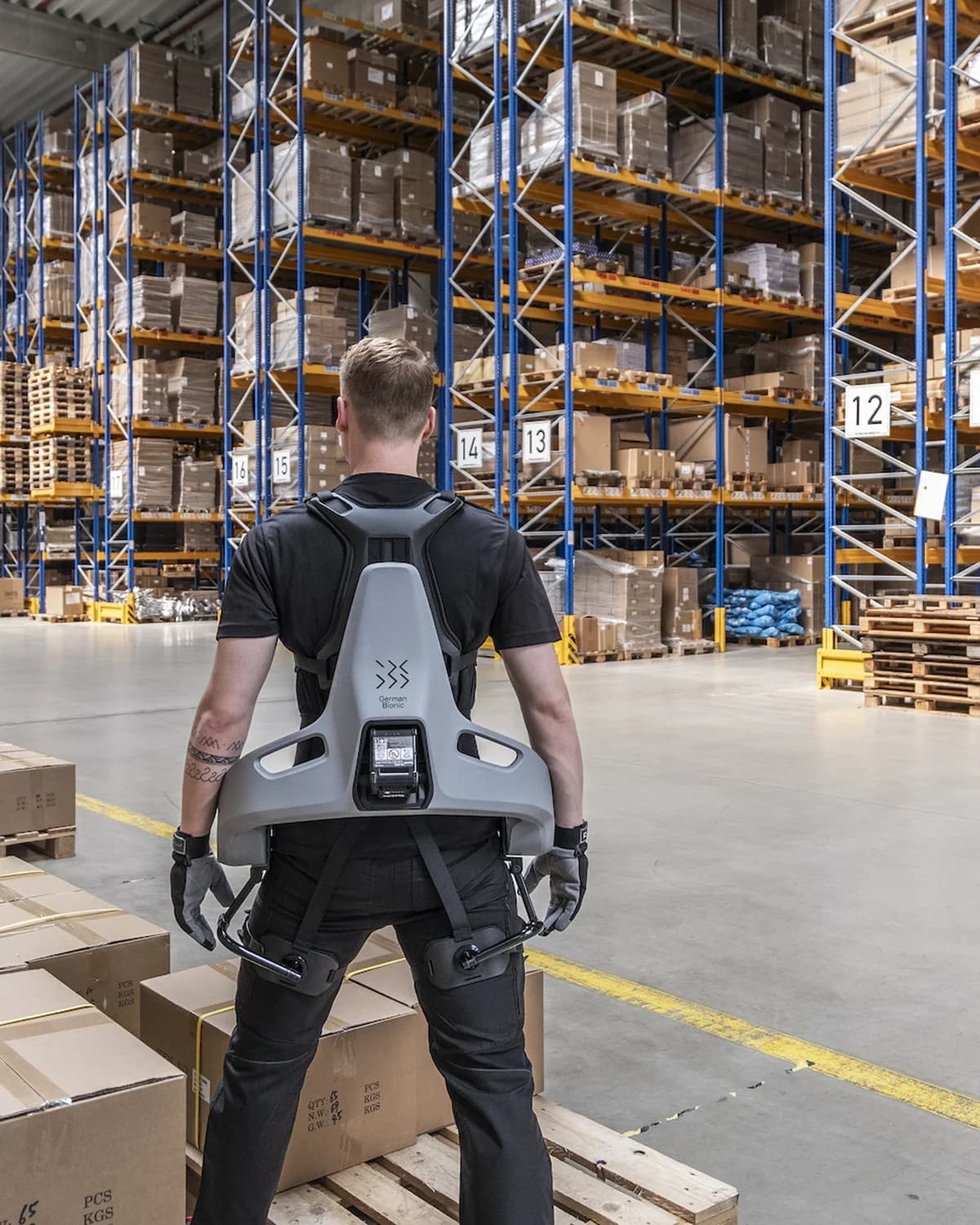
The certification burden tracks the drive architecture. An active exoskeleton such as Cray X carries a lithium-ion battery (hot-swappable, 8 h life, 2 h charge), IMU and load sensors, and Bluetooth plus cloud connectivity. Each of those adds a compliance file: electrical safety, EMC, battery transport and, where software influences assistance, functional safety arguments. The datasheet lists CE, ISO 13482 and EN 614-1, with 300 N assist force, 30 Nm assist torque and 30 kg lift support — figures that procurement teams should be able to trace to the technical file.
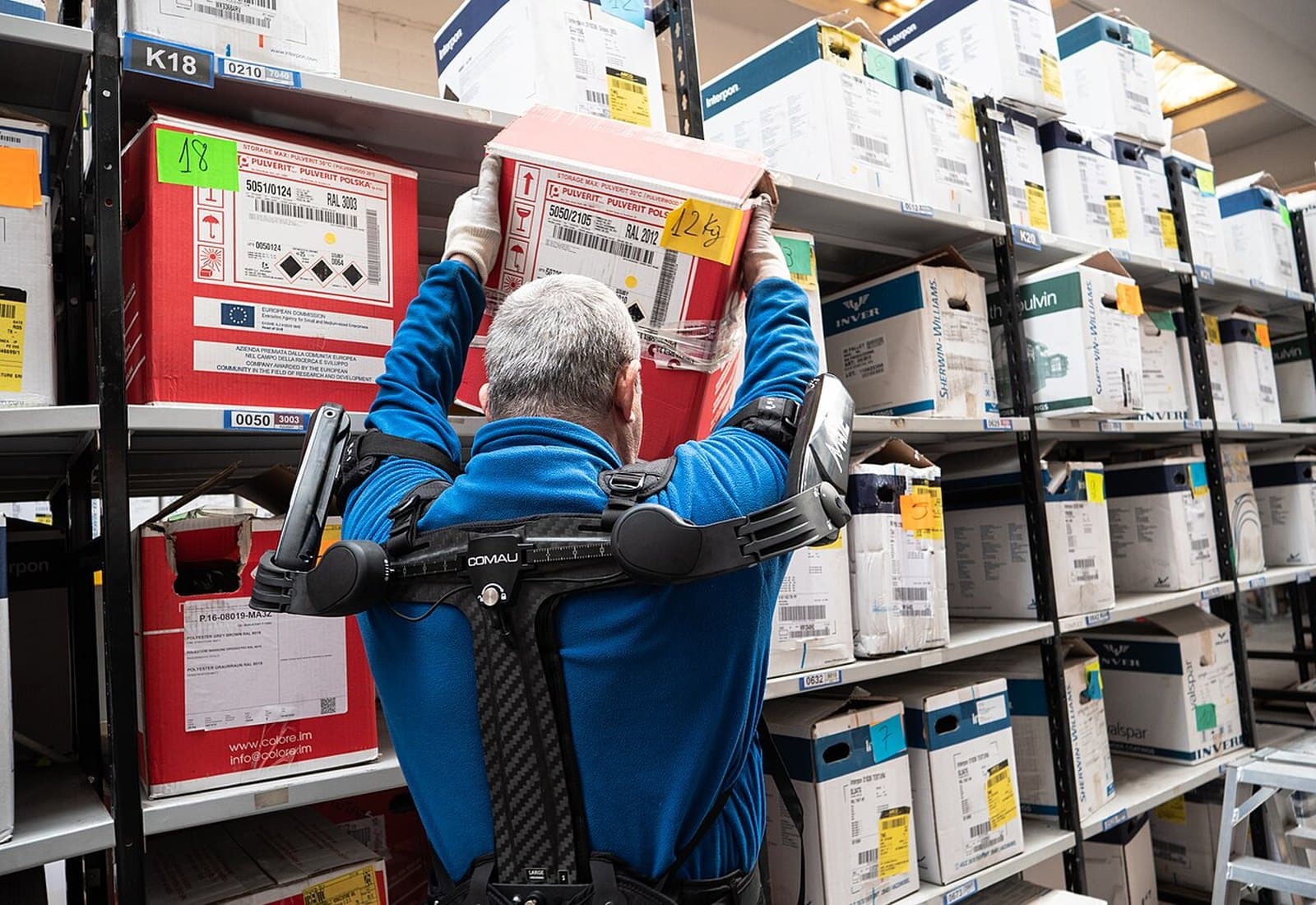
Passive systems — Skelex 360 (70 N assist force, 12 Nm torque), MATE-XT (100 N, 15 Nm), Apex 2 (220 N, 22 Nm) and AIRFRAME (60 N, 10 Nm) — declare no sensors and no battery, so the electrical and software chapters of a conformity file are largely absent. That does not make them unregulated: a wearable device that supports posture and lifting is still assessed against machinery and ergonomics expectations, and the maker must still issue a declaration of conformity. What changes is the depth of evidence a buyer should request.
Declared standards compared
| System | Maker | Drive | Certifications declared | Standards declared | Price from |
|---|
| Cray X | German Bionic | Active | CE, ISO 13482 | ISO 13482, EN 614-1 | 9,900 USD |
| Skelex 360 | Skelex | Passive | CE | ISO 13482 | 4,900 USD |
| MATE-XT | Comau | Passive | CE, ISO 13482 | ISO 13482 | 5,900 USD |
| Apex 2 | HeroWear | Passive | CE | Not disclosed | 1,195 USD |
| AIRFRAME | Levitate Technologies | Passive | CE | Not disclosed | 2,950 USD |
Note the distinction between the certification column and the standards column: Skelex 360 declares ISO 13482 as a standard but lists only CE under certifications, while MATE-XT lists ISO 13482 in both. Apex 2 and AIRFRAME declare CE and no standards at all. Buyers should ask each maker to reconcile these two fields in writing.
What ISO 13482 does and does not cover
ISO 13482 addresses personal care robots, including wearable physical assistant robots, and is the standard most often cited for exoskeletons that operate in close contact with a person. Declaring it signals that the maker has worked through hazard identification for physical contact, restraint, and misuse. It is not, by itself, a certificate, and it does not replace the machinery conformity assessment for a device used in a workplace. Three of the five systems here do not declare it, which is common for passive shoulder supports positioned as PPE-adjacent equipment.
EN 614-1, declared only for Cray X, concerns ergonomic design principles for machinery. Its presence on the datasheet is a useful signal for buyers running workplace ergonomics programmes, but it is one input to a risk assessment, not a substitute for one. See the industrial exoskeleton category for the full field of systems and their declared data.
Documentation to request before purchase
Because the database does not disclose notified body details, EU-type examination certificates, EMC test reports, battery UN transport classifications or software safety levels for any of these systems, procurement should treat those as open items. A practical request list: the signed EU declaration of conformity with the exact directives and standards cited; the name and number of any notified body involved; the risk assessment summary covering the assisted task; battery transport documentation for Cray X; and the declared user limits — Cray X 110 kg user weight and 160–195 cm height, Skelex 360 110 kg and 160–195 cm, MATE-XT 100 kg and 155–195 cm, Apex 2 125 kg and 150–200 cm, AIRFRAME 113 kg and 157–198 cm.
Also confirm that the certificate covers the configuration you are buying. Sizes, frame variants and control modes differ across the range — Cray X offers two frame sizes and adaptive lift assistance plus sit-to-stand support, while Apex 2 offers XS–XXL and task-selectable support. A conformity file that covers one variant may not cover another.
Commercial implications for buyers
Certification scope affects lead time and total cost. Cray X quotes 6–10 weeks, MATE-XT 4–8 weeks, Apex 2 2–4 weeks, while Skelex 360 and AIRFRAME list “contact maker.” Where a buyer needs a specific standard cited in a tender, the shortlist narrows quickly: only Cray X and MATE-XT declare ISO 13482 under certifications, and only Cray X declares EN 614-1. For a side-by-side view of declared specifications, use the comparison tool.
Warranty data is sparse: Skelex 360 declares 24 months and Apex 2 declares 12 months; the other three do not disclose warranty terms. Regional availability also matters for conformity — Cray X, Skelex 360 and MATE-XT list Europe and North America, MATE-XT adds Asia-Pacific, and AIRFRAME lists North America only. A CE declaration is the relevant evidence in the EU; buyers deploying elsewhere should ask what local marking and registration the maker holds.
FAQ
Is CE marking enough for an industrial exoskeleton?
CE marking is the declared minimum across all five systems here, but it is a claim of conformity, not a test report. Ask for the declaration of conformity and the standards it cites; only Cray X and MATE-XT additionally declare ISO 13482 under certifications.
Do passive exoskeletons need certification?
Yes — a wearable device used in the workplace still requires a conformity assessment and a declaration. Passive systems such as Skelex 360, MATE-XT, Apex 2 and AIRFRAME declare CE, though Apex 2 and AIRFRAME list no standards and Skelex 360 lists ISO 13482 only as a standard.
Which system has the broadest declared certification?
German Bionic Cray X, which declares CE, ISO 13482 and EN 614-1 — the widest set in the database. Comau MATE-XT is next with CE and ISO 13482 in both fields. Notified body details are not disclosed for any system.
For tender-specific documentation requests, send an inquiry and specify the standards your procurement policy requires.
 ExoSelect research