Quick answer
For medical exoskeletons, cost of ownership is not disclosed as a single figure by any maker in this dataset; capital price is listed as “on inquiry” for all five systems. Procurement should therefore model total cost across acquisition, consumables, service, training, and clinical support, and treat undisclosed parameters as unknown rather than inferring them.
The total cost of ownership (TCO) for a medical exoskeleton is the sum of acquisition, installation, training, service, consumables, and end-of-life costs over the system’s useful life. In this dataset, no maker publishes a list price or a TCO figure, so buyers must request a formal quotation and a service schedule. This FAQ explains which cost lines are visible in the supplied specifications and which are not disclosed.
Key takeaways
- No price is disclosed for EksoNR, HAL Lower Limb, Indego, Atalante X, or ExoMotus M4; all are “available on inquiry” or programme-based.
- Warranty is 12 months for all five systems, so post-warranty service contracts are a material TCO line.
- Battery life ranges from 3 h to 4 h, and charge time from 2 h to 3 h; swappable batteries are listed for all five, which affects consumable and uptime planning.
- Training and clinical supervision are required by design: EksoNR and ExoMotus M4 are therapist-controlled, and HAL Lower Limb requires a clinical assessment.
- Data connectivity varies from session export to clinical dashboards, which affects integration and reporting costs.
- Certifications differ: FDA and CE for EksoNR and Indego; CE medical for HAL Lower Limb and Atalante X; NMPA and CE for ExoMotus M4.
What cost lines make up medical exoskeleton TCO?
Medical exoskeleton TCO typically includes capital acquisition, delivery and installation, clinician training, warranty and post-warranty service, consumables such as batteries and harnesses, software and data handling, and decommissioning. The DATABASE JSON confirms warranty at 12 months for EksoNR, HAL Lower Limb, Indego, Atalante X, and ExoMotus M4, but does not disclose service contract pricing, consumable pricing, training fees, or installation costs. Those lines must be obtained from each maker’s quotation.
Because priceFrom is null for all five systems, no capital figure can be used in a model. Procurement teams should request a line-item quote that separates hardware, software, training, and service, and should ask for the post-warranty service rate. The absence of a published price is itself a commercial signal: these are configured, clinically supported systems rather than catalogue products.
How do specifications affect operating cost?
Weight, battery life, and charge time drive handling, uptime, and consumable planning. The table below uses only supplied specifications and marks undisclosed parameters as unknown.
| System | Maker | Weight | Battery life | Charge time | Swappable | Warranty | Price |
|---|
| EksoNR | Ekso Bionics | 23.6 kg | 4 h | 2.5 h | Yes | 12 months | Not disclosed |
| HAL Lower Limb | Cyberdyne | 17 kg | 3 h | 2 h | Yes | 12 months | Not disclosed |
| Indego | Parker Hannifin | 12.3 kg | 4 h | 2.5 h | Yes | 12 months | Not disclosed |
| Atalante X | Wandercraft | 65 kg | 4 h | 3 h | Yes | 12 months | Not disclosed |
| ExoMotus M4 | Fourier Intelligence | 23.5 kg | 3 h | 2 h | Yes | 12 months | Not disclosed |
Atalante X is listed at 65 kg and includes 80 kg lift support, which affects floor loading and transport logistics; the other systems range from 12.3 kg to 23.6 kg. All five list swappable batteries, so a spare-battery strategy can reduce downtime, but battery unit pricing is not disclosed. Charge times of 2 h to 3 h imply scheduling discipline in busy clinics.
Which systems carry the highest service and training burden?
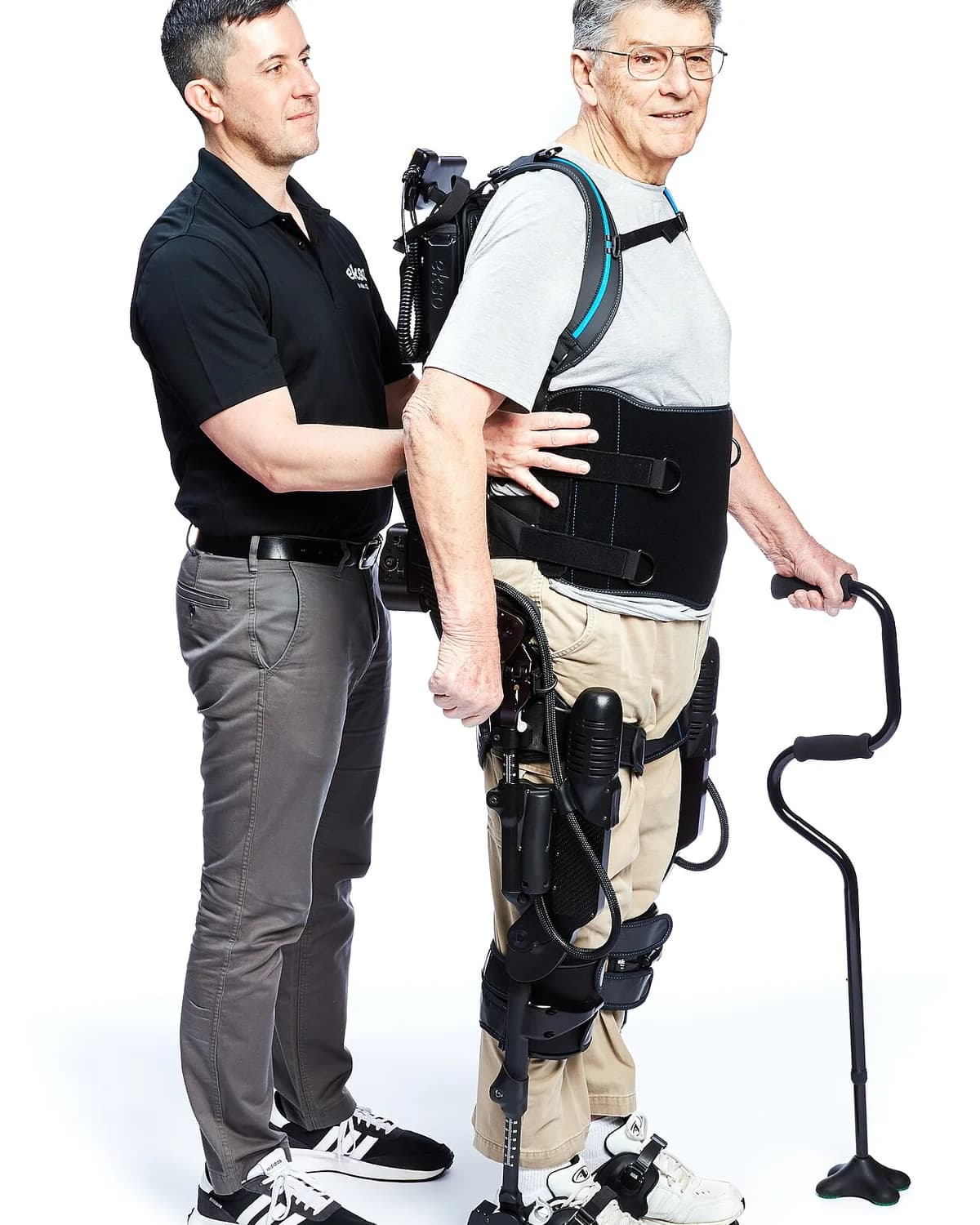
Training burden is highest where the control model requires a therapist or clinician in the loop. EksoNR lists therapist-adjusted variable assistance, sit-to-stand, and step initiation, and its connectivity is EksoPulse clinical software with session data export. HAL Lower Limb uses bioelectric signal control and autonomous gait mode, and its availability is “lease or treatment programme,” which shifts cost from capital to recurring programme fees. ExoMotus M4 is therapist-controlled with assisted gait and training data export.
Indego lists intuitive movement and therapist-controlled gait with Bluetooth and session data logging, while Atalante X uses self-balancing walk and therapist-guided movement with a clinical dashboard. Systems with clinical dashboards or software platforms may carry software licensing and data-handling costs that are not disclosed in the dataset. Buyers should ask whether software is included in the warranty and what happens at month 13.
How should procurement compare quotes when prices are undisclosed?
Use a structured request that forces each maker to disclose the same cost lines. Ask for capital price, delivery and installation, training days and fees, warranty terms, post-warranty service rate, battery and harness pricing, software licence fees, and lead time. Lead time is disclosed for EksoNR at 8–12 weeks; HAL Lower Limb is programme-dependent; Indego and ExoMotus M4 direct buyers to a regional distributor; Atalante X says contact maker. Regional availability also differs: EksoNR covers North America, Europe, and Asia-Pacific; HAL Lower Limb covers Japan, Europe, and Asia-Pacific; Indego covers North America and Europe; Atalante X covers Europe and North America; ExoMotus M4 covers Asia-Pacific, Europe, and the Middle East.
Certification and standards affect compliance cost. EksoNR lists FDA and CE with IEC 60601-1 and IEC 60601-1-2. Indego lists FDA and CE with IEC 60601-1. HAL Lower Limb lists CE medical and ISO 13485 with IEC 60601-1 and ISO 13485. Atalante X lists CE medical with IEC 60601-1 and ISO 13482. ExoMotus M4 lists NMPA and CE with IEC 60601-1. Buyers should confirm that local registration is included in the quoted price; the dataset does not disclose registration fees.
What is not disclosed in this dataset?
The dataset does not disclose capital price, consumable pricing, service contract pricing, training fees, software licence fees, installation cost, or end-of-life cost for any system. It also does not disclose clinical evidence effect sizes, only that published studies exist for each system. Any TCO model must therefore be built from quoted figures, not from inferred numbers. For a side-by-side specification view, see the comparison tool; for category context, see the medical exoskeleton category.
Which product pages should buyers review first?
Start with the system that matches the clinical pathway. EksoNR is a therapist-supervised gait exoskeleton for inpatient and outpatient neurorehabilitation. HAL Lower Limb is a cybernetic assistive limb that reads bioelectric signals. Indego is a modular lower-limb exoskeleton for clinical gait training and personal mobility. Atalante X is a self-balancing robotic exoskeleton for overground gait rehabilitation. ExoMotus M4 is a powered lower-limb exoskeleton for repeatable clinical gait training. For a formal quotation request, use the inquiry form.
FAQ
What is the purchase price of a medical exoskeleton?
Not disclosed. All five systems in this dataset list price as “available on inquiry” or programme-based, so buyers must request a quotation.
How long is the warranty?
12 months for EksoNR, HAL Lower Limb, Indego, Atalante X, and ExoMotus M4. Post-warranty service pricing is not disclosed.
Are batteries included in TCO?
All five systems list swappable lithium-ion batteries, but battery unit pricing and replacement intervals are not disclosed in the dataset.
 ExoSelect research