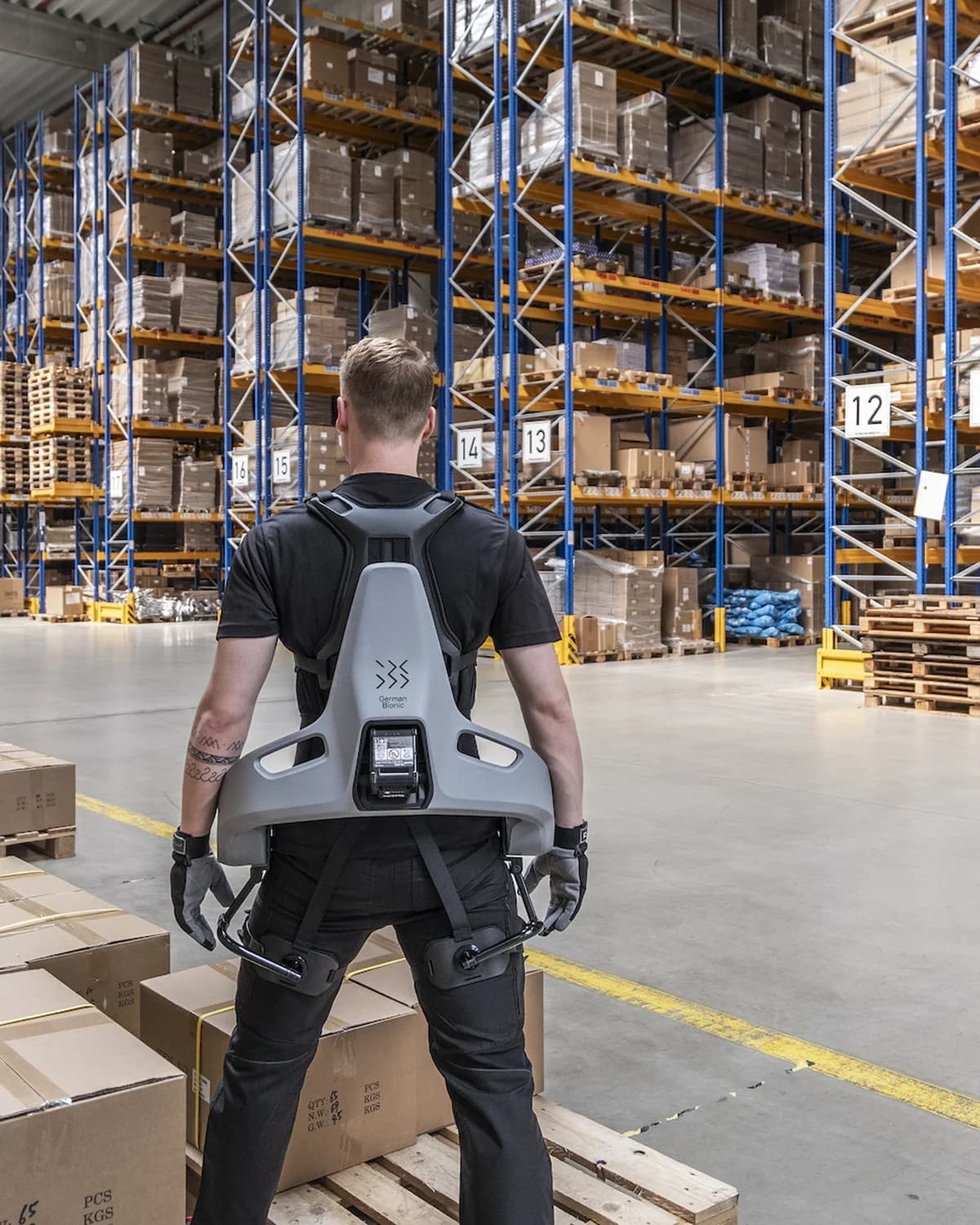
Quick answer: Exoskeleton data privacy risk is concentrated in powered, connected systems. In our database, only the German Bionic Cray X collects usage telemetry via IMU, load sensors, and a cloud fleet dashboard; the passive systems (Skelex 360, MATE-XT, Apex 2, AIRFRAME) have no sensors or connectivity, so they generate no worker data. Buyers must treat the Cray X as a data-processing system, not just a lifting aid.
Exoskeleton data privacy is the set of obligations that arise when an exoskeleton records, transmits, or stores information about the worker wearing it. In industrial procurement, that risk is not evenly distributed: it exists only where the device has sensors and connectivity. According to the ExoSelect database, four of the five industrial systems listed are passive and sensor-free; only the Cray X is a connected, telemetry-generating machine. That single fact should shape your due diligence.
Key takeaways
- Only the German Bionic Cray X (active, 7.6 kg, 300 N assist) collects usage telemetry; it connects via Bluetooth, the Cray Visor app, and a cloud fleet dashboard.
- The passive systems — Skelex 360, Comau MATE-XT, HeroWear Apex 2, and Levitate Technologies AIRFRAME — have no sensors and no connectivity, so they create no digital data-privacy surface.
- Data privacy obligations attach to the Cray X's telemetry, not to the exoskeleton category as a whole.
- The database does not disclose what telemetry the Cray X records, where it is stored, or for how long — these are the questions to put to German Bionic.
- If your works council or data protection officer treats wearable telemetry as employee monitoring, the passive options are the lower-risk procurement path.
Which industrial exoskeletons collect data?
The database records sensors and connectivity for each system. The contrast is stark. The Cray X lists "IMU, Load sensors, Usage telemetry" and "Cray Visor app, Cloud fleet dashboard, Bluetooth." Every other industrial system in the database lists "None" for sensors and "not_applicable" for connectivity. That means the privacy question is effectively a single-product question: Cray X versus the passive field.
This is not a minor distinction. A passive shoulder exoskeleton such as the Skelex 360 (1.6 kg, 70 N assist) or the MATE-XT (4.2 kg, 100 N assist) cannot leak data because it does not generate any. The Apex 2 exosuit (1.2 kg, 220 N assist) and the AIRFRAME (1.5 kg, 60 N assist) are likewise sensor-free. For a procurement team, that is a clean risk boundary.
| System | Maker | Drive | Sensors | Connectivity | Data privacy exposure |
|---|
| Cray X | German Bionic | Active | IMU, Load sensors, Usage telemetry | Cray Visor app, Cloud fleet dashboard, Bluetooth | Yes — telemetry generated and transmitted |
| Skelex 360 | Skelex | Passive | None | Not applicable | None |
| MATE-XT | Comau | Passive | None | Not applicable | None |
| Apex 2 | HeroWear | Passive | None | Not applicable | None |
| AIRFRAME | Levitate Technologies | Passive | None | Not applicable | None |
Source: ExoSelect database. Only supplied specifications are shown; missing parameters are marked not applicable or undisclosed.
What the datasheet doesn't tell you
The Cray X datasheet confirms that telemetry exists, but it does not disclose the parameters that determine your legal exposure. Three gaps matter most.
1. Telemetry content and granularity. The database lists "Usage telemetry" but does not specify whether it records individual lift events, worker identity, time stamps, or only aggregate fleet counts. If the system can attribute lifts to a named worker, it becomes an employee-monitoring tool under many data protection regimes; if it only reports fleet-level utilisation, the risk is far lower. The datasheet does not say which.
2. Data residency and retention. The Cray X uses a "Cloud fleet dashboard." The database does not disclose where that cloud is hosted, whether data leaves the EU or North America, or how long it is retained. For buyers in the EU, this is a GDPR transfer question; for buyers in regulated sectors, it is an audit question. Neither is answered in the supplied specifications.
3. Warranty. The Cray X warranty is listed as "undisclosed." That is not a privacy parameter, but it affects total cost of ownership for a connected device that may require software updates and service contracts. The passive systems disclose warranties where available: Skelex 360 lists 24 months, Apex 2 lists 12 months; MATE-XT and AIRFRAME list warranty as undisclosed or unknown.
None of these gaps can be filled from the database. They must be requested from German Bionic in writing.
Regulatory context: ISO 13482 and data protection are separate questions
The Cray X carries CE marking and lists ISO 13482 and EN 614-1. ISO 13482 is a robot safety standard; it addresses physical risk, not data protection. A CE mark and an ISO 13482 certificate do not tell you whether the telemetry complies with the GDPR, the California Consumer Privacy Act, or works-council agreements. Buyers should not treat safety certification as privacy assurance. The official German Bionic documentation is the place to look for a data processing agreement or privacy notice; the database does not include one.
For a broader view of how these systems compare on non-data specifications, see the industrial exoskeleton category and the comparison tool.
Who should not choose this
If your organisation treats any wearable telemetry as employee monitoring — for example, where a works council must approve individual performance data, or where a data protection officer requires a DPIA before deployment — do not choose the Cray X without first obtaining a written data processing agreement and a clear statement of what is recorded. The passive systems in this database are the lower-risk choice for those environments because they generate no data at all. Conversely, if you need active lift assistance (300 N, 30 Nm, 30 kg lift support) and your privacy review is comfortable with fleet-level telemetry, the Cray X is the only active option listed here. The stance is simple: match the data risk to the device, not to the category.
Procurement checklist for data privacy
- Ask the maker for a data processing agreement and a privacy notice before any pilot.
- Request the telemetry schema: what fields are recorded, at what frequency, and whether worker identity is included.
- Confirm cloud hosting location and retention period in writing.
- Check whether telemetry can be disabled or run in a local-only mode; the database does not state this.
- For passive systems, confirm in the contract that no sensors or connectivity are present — the database lists none, but the purchase order should reflect it.
FAQ
Does every industrial exoskeleton collect worker data?
No. In the ExoSelect database, only the German Bionic Cray X lists sensors and connectivity. The Skelex 360, Comau MATE-XT, HeroWear Apex 2, and Levitate Technologies AIRFRAME list no sensors and no connectivity, so they do not generate digital data.
Is the Cray X GDPR-compliant?
The database does not contain a compliance statement. The Cray X lists CE and ISO 13482, which are safety certifications, not data protection certifications. GDPR compliance depends on the data processing agreement and the telemetry design, neither of which is disclosed in the supplied specifications.
What data does the Cray X record?
The database states "IMU, Load sensors, Usage telemetry" and connectivity via the Cray Visor app, cloud fleet dashboard, and Bluetooth. The specific fields, granularity, retention, and hosting location are not disclosed. Buyers should request them from German Bionic.
Next step: if you are evaluating the Cray X, request the telemetry schema and data processing agreement from German Bionic before you commit to a pilot. If you need a sensor-free alternative, compare the passive systems in the ExoSelect comparison tool or contact the selection desk for a shortlist based on your privacy constraints.
 ExoSelect research