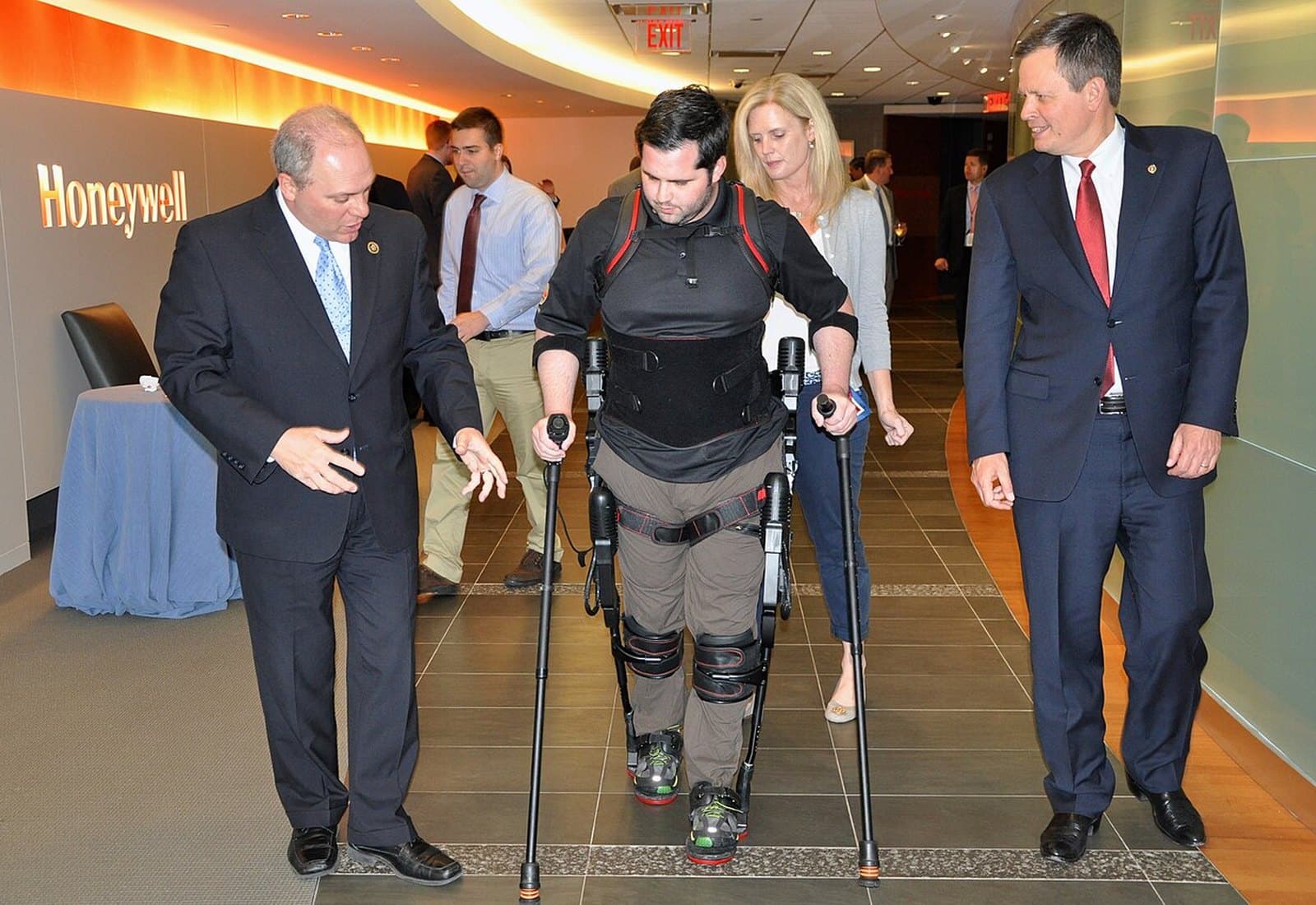
Quick answer: For spinal cord injury (SCI), exoskeletons range from the Ottobock C-Brace—a microprocessor-controlled stance-and-swing leg orthosis for lower-limb impairment—to powered clinical gait systems like EksoNR, Indego, HAL Lower Limb, and ExoMotus M4. Selection depends on injury level, rehabilitation phase, and whether the device is for clinical training or personal mobility; all require clinical fitting and assessment.
The term “exoskeleton for spinal cord injury” covers two distinct device classes: wearable orthoses such as the Ottobock C-Brace that support stance and swing during daily living, and powered gait-training exoskeletons used under therapist supervision in rehabilitation settings. This spotlight compares the C-Brace with four clinical gait systems using supplied specifications, and outlines procurement considerations for engineering and clinical buyers.
Key takeaways
- The C-Brace is a microprocessor-controlled leg orthosis (2.4 kg, 1 degree of freedom) for lower-limb impairment, not a full-body exoskeleton.
- Powered clinical exoskeletons (EksoNR, Indego, HAL Lower Limb, ExoMotus M4) are therapist-supervised and intended for gait training; they are not typically prescribed for unsupervised home use.
- User weight limits range from 100 kg to 120 kg across the supplied devices; height ranges and adjustability vary.
- Battery life ranges from 3 h to 24 h depending on device class and use case.
- All devices require clinical assessment and fitting; availability and lead times differ by region.
- Pricing is not disclosed for any device in the database; procurement should request quotes via inquiry.
Understanding spinal cord injury exoskeleton categories
SCI exoskeletons fall into two broad categories. First, stance-control orthoses like the C-Brace by Ottobock are wearable, user-operated devices that provide knee and ankle stability during walking for individuals with conditions such as knee-extension deficits. The C-Brace uses angle and load sensors with microprocessor stance and swing control, and is custom-fitted. Second, powered gait exoskeletons such as EksoNR (Ekso Bionics), Indego (Parker Hannifin), HAL Lower Limb (Cyberdyne), and ExoMotus M4 (Fourier Intelligence) are motorized frames that move the user’s legs through pre-programmed or therapist-controlled gait patterns. These are used in clinical rehabilitation to deliver repetitive, consistent stepping practice.
The distinction matters for procurement: the C-Brace is a personal orthosis intended for daily use, while the powered systems are capital equipment for rehabilitation facilities. The C-Brace is available through clinical fitting in Europe and North America; the others are available on inquiry or via treatment programmes, with regional availability varying.
Device profiles and specifications
Ottobock C-Brace: A microprocessor-controlled stance-and-swing leg orthosis. Weight 2.4 kg; user weight up to 120 kg; 1 degree of freedom; carbon fibre and aluminium construction; lithium-ion battery with 24 h life and 4 h charge time; sensors include angle and load sensors; connectivity via fitting and diagnostic software; certifications CE medical and FDA; standards ISO 13485 and IEC 60601-1; clinical evidence in knee-extension deficits; warranty 24 months; available through clinical fitting in Europe and North America; lead time fitting-dependent.
Ekso Bionics EksoNR: A therapist-supervised gait exoskeleton for inpatient and outpatient neurorehabilitation. Weight 23.6 kg; height range 152–193 cm; user weight up to 100 kg; assist torque 40 Nm; speed 1.1 km/h; 4 degrees of freedom; level ground and ramps (stair training not supported); removable lithium-ion battery with 4 h life and 2.5 h charge; control modes include therapist-adjusted variable assistance, sit-to-stand, and step initiation; sensors include joint encoders, force sensors, and inertial measurement units; connectivity via EksoPulse clinical software; certifications FDA and CE; standards IEC 60601-1 and IEC 60601-1-2; clinical evidence includes published stroke and spinal cord injury rehabilitation studies; warranty 12 months; available on inquiry in North America, Europe, and Asia-Pacific; lead time 8–12 weeks.
Cyberdyne HAL Lower Limb: A cybernetic assistive limb that reads bioelectric signals to support hip and knee movement. Weight 17 kg; height range 145–190 cm; user weight up to 100 kg; assist torque 40 Nm; speed 1.5 km/h; 2 degrees of freedom; level walking with clinical assessment required; lithium-ion battery with 3 h life and 2 h charge; swappable battery; control modes include bioelectric signal control and autonomous gait mode; sensors include bioelectric signal sensors, joint angle sensors, and force sensors; connectivity via treatment data logging; certifications CE medical and ISO 13485; standards IEC 60601-1 and ISO 13485; clinical evidence in stroke, SCI, and neuromuscular conditions; warranty 12 months; availability via lease or treatment programme in Japan, Europe, and Asia-Pacific; lead time programme-dependent.
Fourier Intelligence ExoMotus M4: A powered lower-limb exoskeleton for repeatable clinical gait training. Weight 23.5 kg; height range 155–190 cm; user weight up to 100 kg; speed 1.2 km/h; 4 degrees of freedom; level walking with clinical assessment required; lithium-ion battery with 3 h life and 2 h charge; swappable battery; control modes include therapist-controlled and assisted gait; sensors include joint encoders and force sensors; connectivity via training data export; certifications NMPA and CE; standards IEC 60601-1; clinical evidence includes clinical rehabilitation studies in China; warranty 12 months; available on inquiry in Asia-Pacific, Europe, and Middle East; lead time contact regional distributor.
Parker Hannifin Indego: A modular lower-limb exoskeleton for clinical gait training and personal mobility. Weight 12.3 kg; height range 155–195 cm; user weight up to 113 kg; speed 2 km/h; 4 degrees of freedom; sit-to-stand and level walking (clinical assessment required for stairs); lithium-ion battery with 4 h life and 2.5 h charge; swappable battery; control modes include intuitive movement and therapist-controlled gait; sensors include joint position sensors and force sensors; connectivity via Bluetooth and session data logging; certifications FDA and CE; standards IEC 60601-1; clinical evidence includes peer-reviewed gait training studies; warranty 12 months; available on inquiry in North America and Europe; lead time contact regional distributor.
Comparison table: C-Brace vs. clinical gait exoskeletons
| Specification | C-Brace | EksoNR | HAL Lower Limb | ExoMotus M4 | Indego |
|---|
| Maker | Ottobock | Ekso Bionics | Cyberdyne | Fourier Intelligence | Parker Hannifin |
| Drive | Active | Active | Hybrid | Active | Active |
| Weight | 2.4 kg | 23.6 kg | 17 kg | 23.5 kg | 12.3 kg |
| User weight max | 120 kg | 100 kg | 100 kg | 100 kg | 113 kg |
| Height range | Custom fitted cm | 152–193 cm | 145–190 cm | 155–190 cm | 155–195 cm |
| Degrees of freedom | 1 | 4 | 2 | 4 | 4 |
| Assist torque | Not disclosed | 40 Nm | 40 Nm | Not disclosed | Not disclosed |
| Speed | Not disclosed | 1.1 km/h | 1.5 km/h | 1.2 km/h | 2 km/h |
| Battery life | 24 h | 4 h | 3 h | 3 h | 4 h |
| Charge time | 4 h | 2.5 h | 2 h | 2 h | 2.5 h |
| Certifications | CE medical, FDA | FDA, CE | CE medical, ISO 13485 | NMPA, CE | FDA, CE |
| Warranty | 24 months | 12 months | 12 months | 12 months | 12 months |
| Availability | Clinical fitting | On inquiry | Lease or treatment programme | On inquiry | On inquiry |
Note: “Not disclosed” indicates the specification is not present in the supplied database. All data is as provided; no values are inferred.
Selection criteria for SCI exoskeletons
Procurement for SCI should begin with the intended use case. For personal mobility at home or in the community, a lightweight, user-operated orthosis like the C-Brace may be appropriate, subject to clinical fitting and assessment of knee-extension deficits. For rehabilitation facilities, powered exoskeletons offer adjustable assistance and session data logging, but require therapist supervision and have higher weight and space requirements.
Key technical parameters to compare include user weight capacity, height range, degrees of freedom, battery life, and control modes. The C-Brace has the highest user weight capacity (120 kg) and longest battery life (24 h) among the supplied devices, but only 1 degree of freedom and custom fitting. The powered exoskeletons offer 2–4 degrees of freedom and speeds up to 2 km/h (Indego), with battery life of 3–4 h. None of the devices disclose pricing; buyers should use the inquiry process to obtain quotes and lead times.
Certifications and standards are also critical. All devices carry CE medical or FDA marks, and several comply with IEC 60601-1. The C-Brace additionally lists ISO 13485 and a 24-month warranty. Clinical evidence varies: the C-Brace cites studies in knee-extension deficits, while EksoNR, HAL, and Indego cite SCI or gait-training studies. ExoMotus M4 cites clinical rehabilitation studies in China. Buyers should request the specific published studies for their patient population.
Procurement and integration considerations
For hospitals and rehabilitation centres, the powered exoskeletons require dedicated space, trained therapists, and charging infrastructure. The EksoNR has a lead time of 8–12 weeks; others are contact-regional-distributor or programme-dependent. The C-Brace is fitted through clinical channels, with lead time fitting-dependent. Regional availability differs: C-Brace in Europe and North America; EksoNR in North America, Europe, and Asia-Pacific; HAL in Japan, Europe, and Asia-Pacific; ExoMotus M4 in Asia-Pacific, Europe, and Middle East; Indego in North America and Europe.
Data connectivity is another factor: EksoNR offers EksoPulse clinical software and session data export; Indego provides Bluetooth and session data logging; HAL logs treatment data; ExoMotus M4 exports training data; C-Brace uses fitting and diagnostic software. For a deeper comparison, see the compare tool and the medical exoskeleton category page.
FAQ
What is the difference between the C-Brace and a powered exoskeleton for SCI?
The C-Brace is a microprocessor-controlled leg orthosis (2.4 kg, 1 degree of freedom) for stance and swing control, custom-fitted and user-operated. Powered exoskeletons like EksoNR, Indego, HAL, and ExoMotus M4 are motorized frames (12.3–23.6 kg, 2–4 degrees of freedom) used under therapist supervision for gait training.
Can any of these exoskeletons be used at home without supervision?
The C-Brace is designed for personal use following clinical fitting. The powered exoskeletons in this database are described as therapist-supervised or clinical-assessment-required; their availability is on inquiry or via treatment programmes, and they are not indicated for unsupervised home use in the supplied data.
What are the user weight limits for SCI exoskeletons?
From the supplied specifications: C-Brace 120 kg; Indego 113 kg; EksoNR, HAL Lower Limb, and ExoMotus M4 each 100 kg. Height ranges vary from custom fitted (C-Brace) to 145–195 cm for adjustable systems.
For procurement support, request quotes and clinical evidence via inquiry.
 ExoSelect research