Quick answer: An exoskeleton pilot program checklist must verify five things before purchase: (1) the device's assist profile matches the task's force and torque demands, (2) fit range covers your workforce anthropometry, (3) certification and standards are documented for your region, (4) total cost includes training, spares and warranty terms, and (5) success metrics are defined upfront. For a passive back-assist pilot, the HeroWear Apex 2 offers 220 N assist force, 22 Nm torque and 1.2 kg weight at an indicative $1,195, but its standards referenced and clinical evidence are not disclosed in the dataset—so your checklist must demand those documents from the maker.
The first sentence of any pilot checklist should be: define the task and the success metric before selecting hardware. A generic top-10 list will not tell you that the Apex 2's 220 N assist force is fixed by elastic bands and task-selectable support, nor that its CE mark alone does not reference ISO 13482 in the supplied data. This spotlight gives procurement and engineering teams a checklist grounded in the Apex 2 dataset, with explicit gaps and a stance on when to walk away.
Key takeaways
- Start with task force and torque, not brand. The Apex 2 supplies 220 N assist force and 22 Nm assist torque; match those to your lift profile before piloting.
- Fit range is a gate. Apex 2 covers 150–200 cm height and 125 kg user weight across XS–XXL; verify your population falls inside.
- Certification is not a checkbox. Apex 2 lists CE only; standards referenced are unknown in the dataset—request the declaration of conformity.
- Total cost includes more than unit price. The $1,195 indicative price excludes training, spare parts and the 12-month warranty limit.
- Pilot success needs a baseline. Without pre-pilot injury or fatigue data, a pilot cannot prove ROI.
Pilot checklist: what to verify before day one
A pilot program fails when it starts with hardware selection instead of task analysis. The checklist below is ordered by procurement risk, using the Apex 2 as the reference system. Each item names a parameter you can confirm from the dataset or must request from the maker.
- Task force and torque match. Apex 2: 220 N assist force, 22 Nm assist torque. Confirm your heaviest repeated lift does not exceed the 20 kg lift support figure.
- Anthropometric coverage. Apex 2: 150–200 cm height, 125 kg user weight, sizes XS–XXL. Measure your workforce; anyone outside the range needs a different device.
- Certification and standards. Apex 2: CE. Standards referenced: unknown in the dataset. Request the EU declaration of conformity and any ISO 13482 assessment.
- Warranty and spares. Apex 2: 12 months warranty. Ask for spare parts pricing and expected replacement interval for elastic bands.
- Training and fitting time. Not disclosed in the dataset. Budget for a fitter and a training session per user.
- Success metrics. Define baseline injury rate, fatigue score or productivity metric before the pilot; the dataset contains no clinical evidence for Apex 2.
- Exit criteria. Agree in advance what result ends the pilot—e.g., no reduction in reported discomfort after four weeks.
Comparison table: Apex 2 against adjacent industrial systems
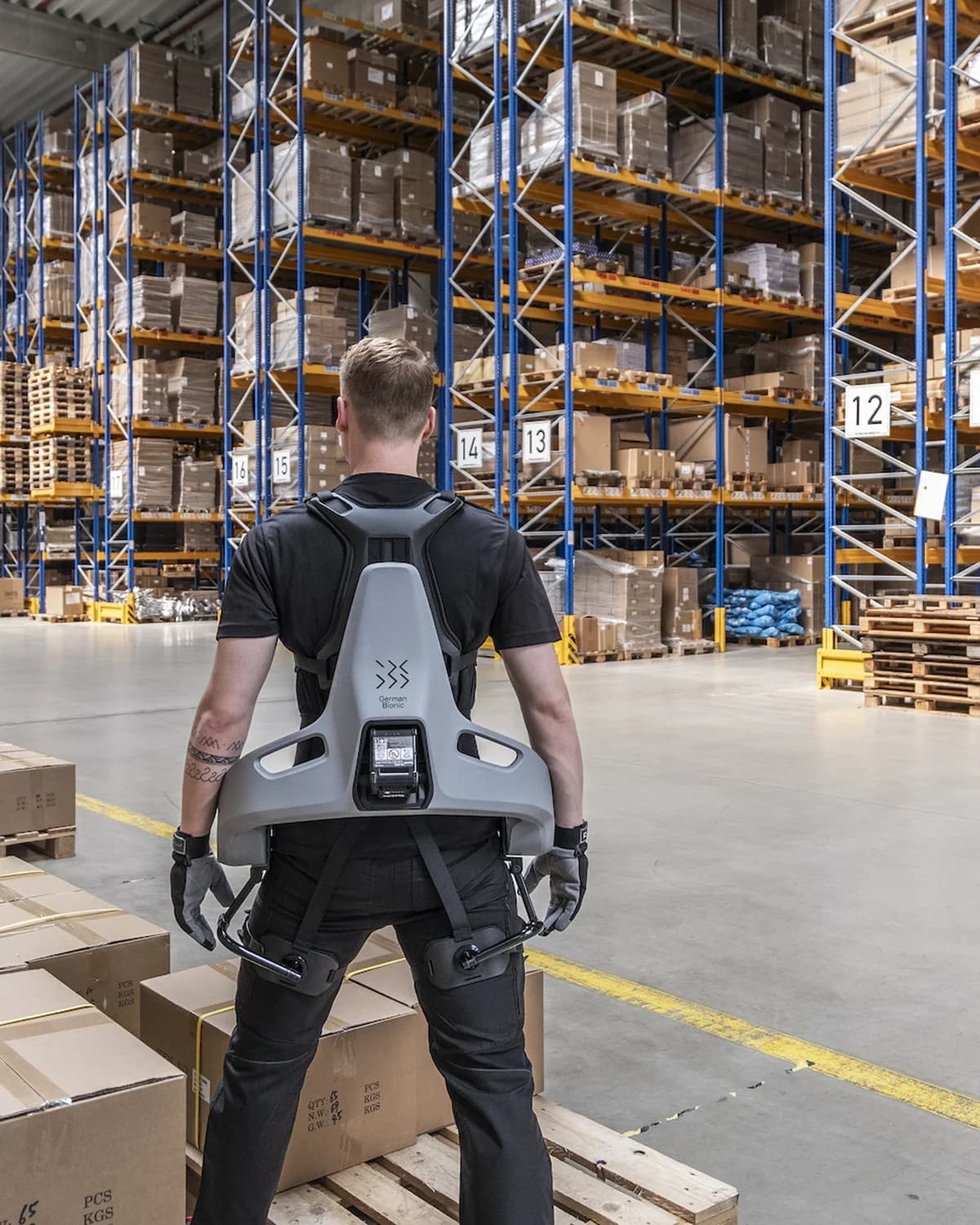
The table uses only supplied dataset values. It shows why a pilot checklist must be device-specific: the Cray X is active and connected, while the Apex 2 is passive with no sensors or connectivity.
| Parameter | HeroWear Apex 2 | German Bionic Cray X | Skelex 360 | Comau MATE-XT |
|---|
| Drive | Passive | Active | Passive | Passive |
| Weight | 1.2 kg | 7.6 kg | 1.6 kg | 4.2 kg |
| Assist force | 220 N | 300 N | 70 N | 100 N |
| Assist torque | 22 Nm | 30 Nm | 12 Nm | 15 Nm |
| Lift support | 20 kg | 30 kg | 5 kg | 5 kg |
| Height range | 150–200 cm | 160–195 cm | 160–195 cm | 155–195 cm |
| User weight | 125 kg | 110 kg | 110 kg | 100 kg |
| Certifications | CE | CE, ISO 13482 | CE | CE, ISO 13482 |
| Standards referenced | Unknown | ISO 13482, EN 614-1 | ISO 13482 | ISO 13482 |
| Warranty | 12 months | Undisclosed | 24 months | Undisclosed |
| Price from (USD) | 1,195 | 9,900 | 4,900 | 5,900 |
| Lead time | 2–4 weeks | 6–10 weeks | Contact maker | 4–8 weeks |
Use the compare tool to put these systems side by side on your own criteria.
What the datasheet doesn't tell you
The Apex 2 dataset is 94% complete, but the missing 6% matters for a pilot. Three parameters are either unknown or not applicable, and each changes how you plan.
Standards referenced: unknown. The dataset lists CE certification but does not state which harmonised standards the declaration of conformity cites. For a European pilot, CE alone does not prove conformity to ISO 13482—the robot safety standard some buyers expect. You must request the declaration of conformity and check whether ISO 13482 is referenced. Without it, your safety file is incomplete.
Clinical evidence: not applicable. This is a passive industrial exosuit; the dataset records no clinical evidence. A pilot cannot claim injury-prevention efficacy from the datasheet. If your business case depends on reducing musculoskeletal injury rates, you need your own pre/post data, not a vendor claim.
Training and fitting time: not disclosed. The dataset gives no figure for time to fit or train a user. This is a hidden cost: a pilot with 20 users may need a full day of fitter time. Ask the maker for a documented fitting protocol and training duration before budgeting.
Also missing: spare parts pricing and expected service life of the elastic bands. The 12-month warranty is short relative to a multi-year deployment; model replacement cost into the pilot's total cost of ownership.
Total cost of ownership for an Apex 2 pilot
The $1,195 indicative list price is not the pilot cost. Add fitting and training time (not disclosed), spare elastic bands (price not disclosed), and internal staff time to collect baseline and follow-up metrics. Compare that with the Cray X at $9,900, which includes sensors and connectivity for usage telemetry—useful for a pilot's data collection but heavier at 7.6 kg and with a 6–10 week lead time. The Apex 2's 2–4 week lead time and 1.2 kg weight lower the logistics burden, but the absence of connectivity means your pilot data must be collected manually.
Who should not choose this
Do not choose the Apex 2 if your pilot's primary goal is to generate auditable usage data or to satisfy a safety case that explicitly requires ISO 13482. The dataset shows no sensors, no connectivity and standards referenced as unknown; the Cray X, by contrast, lists IMU, load sensors and usage telemetry plus ISO 13482 and EN 614-1. If your procurement gate requires a cited standard beyond CE, the Apex 2 is the wrong starting point until HeroWear supplies the declaration. Also avoid it if your workforce includes users above 125 kg or outside 150–200 cm—the dataset gives no alternative size.
FAQ
Does the Apex 2 have ISO 13482 certification?
The dataset lists CE certification only and records standards referenced as unknown. Request the declaration of conformity from HeroWear to confirm whether ISO 13482 is cited.
What is the Apex 2 warranty period?
12 months, per the dataset. Spare parts pricing and service life are not disclosed.
Can the Apex 2 be used for overhead work?
No—the dataset describes it as a hip-extension assist for bending and lifting, with 20 kg lift support. For overhead work, compare the Skelex 360 or Comau MATE-XT.
Next step
Before committing to a pilot, request the Apex 2 declaration of conformity and a written fitting/training protocol from HeroWear. Then compare it against the Cray X on data capture and standards, or contact the ExoSelect selection desk for a checklist tailored to your task.
Official source: HeroWear Apex 2 product page.
 ExoSelect research