Quick answer
ISO 13482 is the safety standard for personal care robots, and the German Bionic Cray X lists it alongside CE in its datasheet. That listing signals a design and risk-assessment framework, not a guarantee that every deployment is compliant; buyers must still obtain the declaration of conformity and confirm the standard’s scope covers the specific workplace task.
If you are procuring the Cray X, the ISO 13482 entry is the single most important compliance claim on the sheet. It tells you the maker has mapped the device against a recognised personal-care-robot safety framework. It does not tell you the standard’s edition, the notified body involved, or whether the assessment covered your lifting profile. Those are the questions this spotlight answers.
Key takeaways
- Only one system in this dataset, the German Bionic Cray X, lists ISO 13482; the passive devices list CE only or leave standards unknown.
- ISO 13482 is a personal care robot standard, so its fit for an industrial back exoskeleton depends on the risk assessment and the declared scope.
- The Cray X datasheet discloses weight (7.6 kg), assist force (300 N), assist torque (30 Nm), lift support (30 kg) and an 8 h hot-swappable battery, but not warranty terms.
- Passive systems such as Skelex 360 and MATE-XT list CE and ISO 13482 in some cases, but the dataset shows no ISO 13482 entry for Apex 2 or AIRFRAME.
- Certification is a procurement gate, not a performance metric; pair it with the declared assist limits and user-weight range.
What ISO 13482 actually covers — and what it does not
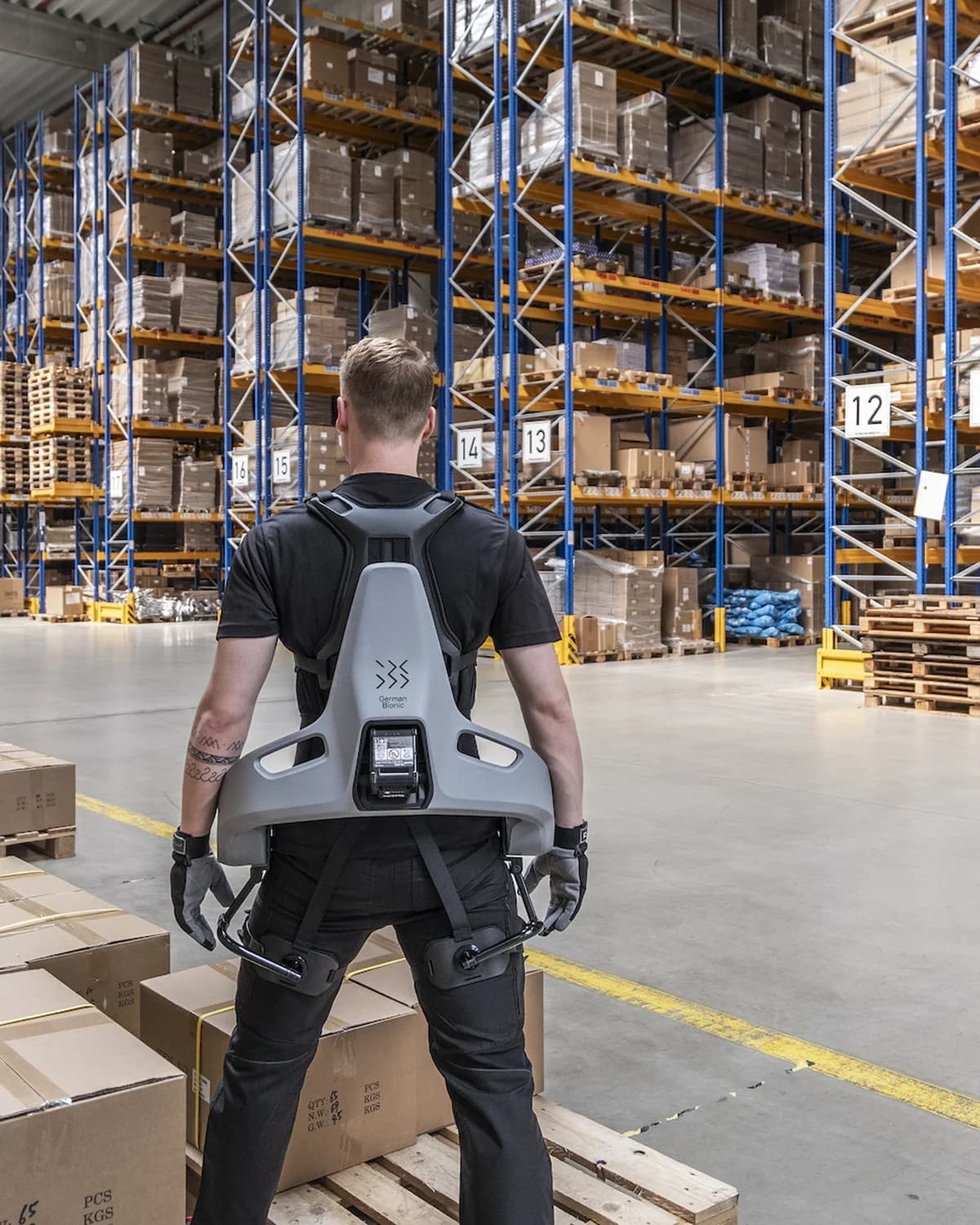
ISO 13482 is titled “Robots and robotic devices — Safety requirements for personal care robots.” It addresses physical hazards such as crushing, trapping, and unintended contact for robots that operate in close proximity to people. An active back exoskeleton like the Cray X fits that description: it applies force to a wearer, has moving parts, and relies on sensors and control logic.
The standard is not a product-performance certificate. It does not validate assist force, battery runtime, or ergonomic benefit. The Cray X datasheet lists 300 N assist force and 30 Nm assist torque; ISO 13482 says nothing about whether those values are appropriate for a given task. That distinction matters because procurement teams sometimes treat a standards entry as a proxy for suitability. It is not.
The standard also does not replace the machinery directive or the employer’s own risk assessment. A CE mark and an ISO 13482 reference indicate that the maker has followed a conformity route; they do not transfer the duty of care to the manufacturer. The buyer still owns the workplace risk assessment.
How the dataset compares on standards
The table below uses only the supplied DATABASE JSON. Where a field is absent, it is marked as not disclosed or unknown.
| System | Maker | Drive | Certifications listed | Standards listed | Price from (USD) |
|---|
| Cray X | German Bionic | Active | CE, ISO 13482 | ISO 13482, EN 614-1 | 9,900 |
| Skelex 360 | Skelex | Passive | CE | ISO 13482 | 4,900 |
| MATE-XT | Comau | Passive | CE, ISO 13482 | ISO 13482 | 5,900 |
| Apex 2 | HeroWear | Passive | CE | Unknown | 1,195 |
| AIRFRAME | Levitate Technologies | Passive | CE | Unknown | 2,950 |
Two patterns stand out. First, ISO 13482 appears on both active and passive systems, which is consistent with the standard’s hazard-based rather than drive-based logic. Second, the absence of a standards entry for Apex 2 and AIRFRAME is not evidence of non-compliance; it is an information gap. The dataset marks those fields as unknown, and buyers should treat them as unverified until the maker supplies a declaration.
What the datasheet doesn't tell you
The Cray X sheet is unusually complete at 96% completeness, but four parameters remain open. Each one changes the procurement calculation.
Warranty is undisclosed. For a powered system with a lithium-ion battery, a 2 h charge time, and a 7.6 kg carbon-fibre and aluminium frame, warranty terms drive the total cost of ownership. A 24-month warranty on a passive device like the Skelex 360 is visible in the dataset; the Cray X equivalent is not. Without it, fleet buyers cannot model replacement or repair exposure.
Max walking speed is not applicable. That is a category statement, not a missing number: the Cray X is a back-assist device for lifting and forward bending, not a gait system. Buyers should not expect mobility specifications, and should not compare it to lower-limb exoskeletons on that axis.
Stair and slope capability is not applicable. The same logic applies. The device is designed for level industrial floors and lifting tasks; the dataset does not claim climbing capability.
Clinical evidence is not applicable. This is an industrial device, not a medical one. Any ergonomic benefit claim should be sourced from the maker’s own documentation, not inferred from the certification.
The deeper gap is the one the dataset cannot fill: the ISO 13482 declaration itself. The sheet lists the standard but not the edition, the assessment body, or the scope statement. Those documents are what an auditor will ask for.
Why the Cray X is the reference point in this dataset
The Cray X is the only system here that pairs ISO 13482 with EN 614-1, the ergonomic design principles standard for machinery. It is also the only active device, with 300 N assist force, 30 Nm assist torque, and 30 kg lift support. Those numbers are the highest in the dataset for assist force and torque, which is consistent with a powered rather than passive architecture.
The trade-off is weight and price. At 7.6 kg and 9,900 USD indicative, the Cray X sits well above the passive systems: the Skelex 360 is 1.6 kg at 4,900 USD, the MATE-XT is 4.2 kg at 5,900 USD, and the Apex 2 is 1.2 kg at 1,195 USD. The Cray X also carries a 6–10 week lead time, longer than the Apex 2’s 2–4 weeks. Buyers choosing the Cray X are buying active assistance and a connected telemetry stack (Cray Visor app, cloud fleet dashboard, Bluetooth), not a low-cost passive aid.
For a broader view of how these systems sit against each other, see the comparison tool and the industrial exoskeleton category.
Who should not choose this
Do not choose the Cray X if your procurement gate requires a disclosed warranty before purchase. The dataset does not provide one, and a powered exoskeleton with a hot-swappable lithium-ion battery is exactly the kind of asset where warranty terms matter most. Ask German Bionic for the warranty schedule in writing before you shortlist.
Do not choose it if your task is overhead work rather than lifting. The Cray X is a back-assist device for lifting, carrying and forward bending; the dataset’s own summary says so. For sustained arm elevation, the passive shoulder systems in this dataset — Skelex 360, MATE-XT, AIRFRAME — are the relevant comparison, and the Cray X’s 300 N assist force is not aimed at that use case.
Do not choose it if you need a low-cost pilot with fast deployment. At 9,900 USD and a 6–10 week lead time, the Cray X is a fleet-scale decision, not a trial unit. The Apex 2 at 1,195 USD and 2–4 weeks is the dataset’s low-friction entry point, though it lacks a listed standards entry.
Choose the Cray X when you need active lift assistance, a documented ISO 13482 reference, and fleet telemetry, and when you are prepared to obtain the declaration of conformity and warranty terms directly from the maker.
FAQ
Does ISO 13482 certification make the Cray X safe for any workplace?
No. ISO 13482 is a safety framework for personal care robots; it does not replace the employer’s risk assessment or confirm suitability for a specific task. The Cray X lists the standard, but the buyer must still verify the declaration and assess the task.
Is ISO 13482 required for industrial exoskeletons?
The dataset does not establish a legal requirement. It shows that some makers list it and others do not. Apex 2 and AIRFRAME have unknown standards entries, which is an information gap rather than proof of non-compliance.
What should I request from German Bionic before buying the Cray X?
Request the ISO 13482 declaration of conformity, the warranty schedule (undisclosed in the dataset), and the scope statement covering your lifting profile. Then compare it against the Skelex 360 and MATE-XT if overhead work is also in scope.
Next step
Request the ISO 13482 declaration of conformity and the warranty schedule from German Bionic for the Cray X, then run the same request against the MATE-XT and Skelex 360 so you compare like documents. If you need help framing the request, contact the ExoSelect selection desk.
 ExoSelect research