Quick answer
The Sarcos Guardian XT is a teleoperated, active robotic system with 14 degrees of freedom, a 45 kg lift capacity, and tetherless operation, designed for hazardous material handling in defense and remote environments. It is not a wearable exoskeleton: it is a mobile manipulator that a human operator controls remotely, and it is available only through Sarcos’s enterprise programme in North America, with no public list price.
If you are searching for a wearable exoskeleton to reduce operator fatigue, the Guardian XT is the wrong category. If you need to move 45 kg objects in a contaminated or unsafe space without putting a person there, it is one of the few documented options. This spotlight separates the two use cases and flags the procurement gaps that a generic top-10 page will miss.
Key takeaways
- Guardian XT is a teleoperated robotic system, not a body-worn exoskeleton; its 14 DoF and 45 kg lift capacity apply to the robot, not to human augmentation.
- Runtime, charge time, certifications, standards, warranty, and price are all unknown or undisclosed in the public dataset.
- Availability is limited to an enterprise programme in North America; lead time is programme-dependent.
- For wearable load carriage in defense, the Lockheed Martin ONYX is the closer comparator, with a documented 6.3 kg weight and 8 h battery life.
- Buyers should request a documented runtime and certification matrix before any site trial.
What the Guardian XT actually is
The Guardian XT is made by Sarcos and sits in the defense category of the ExoSelect database. Its summary describes it as “a teleoperated dexterous robotic system for hazardous and remote material handling.” The drive is active, the control modes are teleoperation and motion mapping, and the sensor suite includes stereo cameras, force feedback, and joint encoders. Connectivity is tetherless teleoperation. The system weighs 55 kg, uses aluminium and steel, and is built on a mobile base configuration.
That specification set describes a remote manipulator on a mobile platform, not a wearable exoskeleton. The 14 degrees of freedom refer to the robot’s arms and end effectors, and the 45 kg lift support is the robot’s payload, not human assist force. Buyers who arrive at this page expecting a back-assist or full-body exoskeleton should redirect to the Lockheed Martin ONYX for powered load carriage or to passive industrial systems such as the HeroWear Apex 2 for human-worn lifting support.
Specifications that matter for selection
The documented specs that drive a selection decision are the 14 DoF, the 45 kg lift support, the tetherless teleoperation, and the force-feedback sensor suite. Those four parameters define the task envelope: dexterous manipulation of loads up to 45 kg at a distance, with the operator receiving force feedback through the control interface. The mobile base and terrain-dependent climbing mean the system is not rail-mounted; it can reposition, but the database does not quantify slope or stair capability.
The 55 kg system weight and aluminium/steel construction matter for transport and deployment logistics. A 55 kg mobile base is not man-portable; it requires a vehicle, a ramp, or a lift for relocation. That is a deployment constraint, not a defect, but it changes the site survey.
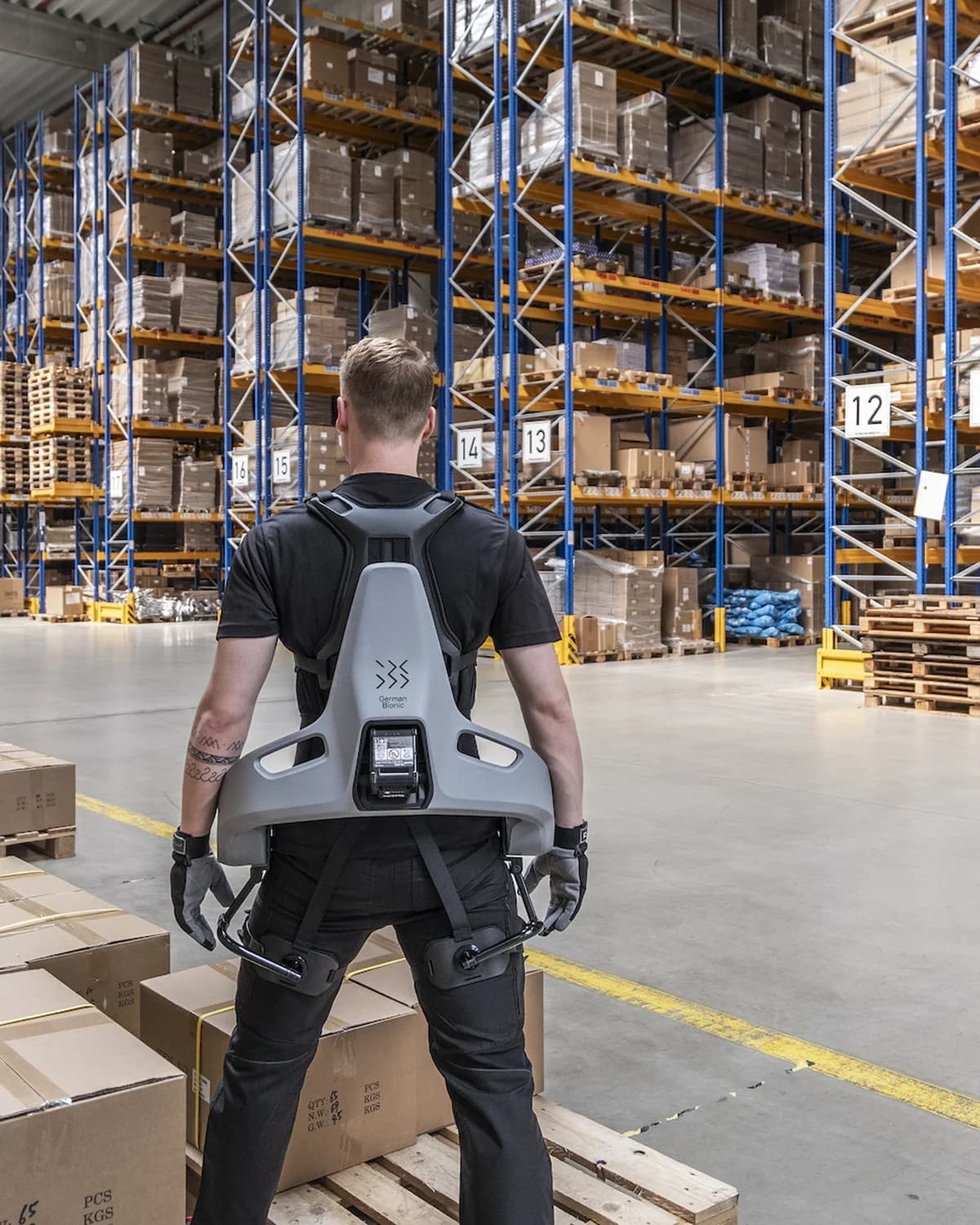
| Parameter | Guardian XT (Sarcos) | ONYX (Lockheed Martin) | Cray X (German Bionic) |
|---|
| Category | Defense | Defense | Industrial |
| Drive | Active | Active | Active |
| Weight | 55 kg | 6.3 kg | 7.6 kg |
| Degrees of freedom | 14 | 2 | 2 |
| Lift support | 45 kg | 45 kg | 30 kg |
| Battery life | Unknown | 8 h | 8 h |
| Control modes | Teleoperation, motion mapping | Powered load-carriage assistance | Adaptive lift assistance, sit-to-stand support |
| Availability | Enterprise programme | Defense programme | Available |
| Regions | North America | North America | Europe, North America |
| Price | Undisclosed | Undisclosed | 9,900 USD indicative |
The table is built only from supplied specs. Note that the 45 kg lift support on the Guardian XT and the ONYX are not equivalent: the Guardian XT lifts as a robot, the ONYX reduces human load carriage. The Cray X is included as a commercial benchmark for price and battery documentation, not as a like-for-like substitute.
What the datasheet doesn't tell you
Runtime and charge time are unknown. For a tetherless teleoperated system, battery life defines the mission window. A defense buyer planning a 4-hour operation cannot size the power budget without a runtime figure. The database lists battery type as lithium-ion and swappable as yes, but neither the runtime nor the charge time is disclosed. That is the single largest gap in the specification set.
Certifications and standards are unknown. The Guardian XT has no listed CE mark, no ISO 13482 reference, and no standards entry. For a North American defense programme that may be acceptable, but for any dual-use or civilian deployment, the absence of a certification matrix is a procurement blocker. Compare with the German Bionic Cray X, which lists CE and ISO 13482, or the Skelex 360, which lists CE and ISO 13482. The Guardian XT does not.
Price and warranty are undisclosed. The price note says “Enterprise programme; no public list price.” Warranty is unknown. For a capital purchase in a defense programme, the absence of a warranty term and a price band makes total-cost-of-ownership modelling impossible without a direct request. The database also marks peak assist force, peak assist torque, and max walking speed as unknown; for a teleoperated robot, walking speed is less relevant, but assist force and torque would clarify manipulation strength at the end effector.
Lead time is programme-dependent. That phrase means the buyer cannot plan a deployment schedule from public data. It also means the commercial terms are negotiated per programme, which shifts risk to the buyer.
Who should not choose this
Do not choose the Guardian XT if your requirement is a wearable exoskeleton for a worker who needs to lift repeatedly during a shift. The 55 kg system weight, the mobile base, and the teleoperation control mode are incompatible with a person-worn device. For that requirement, the ONYX is the documented defense alternative, and the Cray X is the documented industrial alternative with a public price and certification.
Do not choose it if you need a fixed, published price and a standard warranty before committing budget. The enterprise programme model means you will negotiate, and the database does not disclose the warranty term. If your procurement process requires a list price and a warranty certificate at the RFQ stage, the Guardian XT will fail that gate until Sarcos provides them.
Do not choose it if you operate outside North America. The regions field lists North America only. European deployment would require a separate regulatory and support conversation that the public data does not cover.
How to compare it
Use the ExoSelect comparison tool to place the Guardian XT against the ONYX and the Cray X on the documented parameters: weight, DoF, lift support, battery life, and availability. The comparison will show that the Guardian XT is the only system in this set with 14 DoF and tetherless teleoperation, and the only one with no disclosed runtime. That contrast is the useful output: it tells you which questions to send to Sarcos.
For a broader view of the defense category, see the defense exoskeleton category page. For a direct procurement conversation, use the ExoSelect inquiry form to request a documented parameter set from the maker.
FAQ
Is the Guardian XT a wearable exoskeleton?
No. The database describes it as a teleoperated dexterous robotic system with a mobile base, 14 DoF, and 45 kg lift support. It is operated remotely, not worn.
What is the battery life of the Guardian XT?
Unknown. The database lists lithium-ion chemistry and a swappable battery, but runtime and charge time are not disclosed.
Where can I buy the Guardian XT?
Through Sarcos’s enterprise programme in North America. There is no public list price, and lead time is programme-dependent.
Next step
Request the documented runtime, certification matrix, and warranty term from Sarcos before any site evaluation. If you need a wearable defense exoskeleton instead, compare the Lockheed Martin ONYX on the same parameters. The ExoSelect desk can route both requests through the inquiry form.
 ExoSelect research