Quick answer: No exoskeleton in the ExoSelect medical database is cleared or clinically validated for knee osteoarthritis. The systems listed—EksoNR, HAL Lower Limb, Atalante X, Indego and ExoMotus M4—are gait-training devices for neurological rehabilitation, and their published evidence covers stroke and spinal cord injury, not OA. If you are procuring for OA, you are outside the labelled indication and must treat every specification as unverified for that use.
Key takeaways
- All five medical exoskeletons in the database are indicated for neurorehabilitation, not knee osteoarthritis.
- Peak assist torque is disclosed for EksoNR and HAL Lower Limb (40 Nm); Atalante X, Indego and ExoMotus M4 do not disclose it.
- Peak assist force and indicative price are undisclosed across the entire set.
- Weight ranges from 12.3 kg (Indego) to 65 kg (Atalante X)—a deployment constraint, not a datasheet footnote.
- Only Atalante X lists a rated lift support (80 kg); the others mark it not applicable or unknown.
- Certifications differ: EksoNR and Indego carry FDA and CE; HAL and Atalante X are CE medical; ExoMotus M4 is NMPA and CE.
Why knee osteoarthritis is not a listed indication
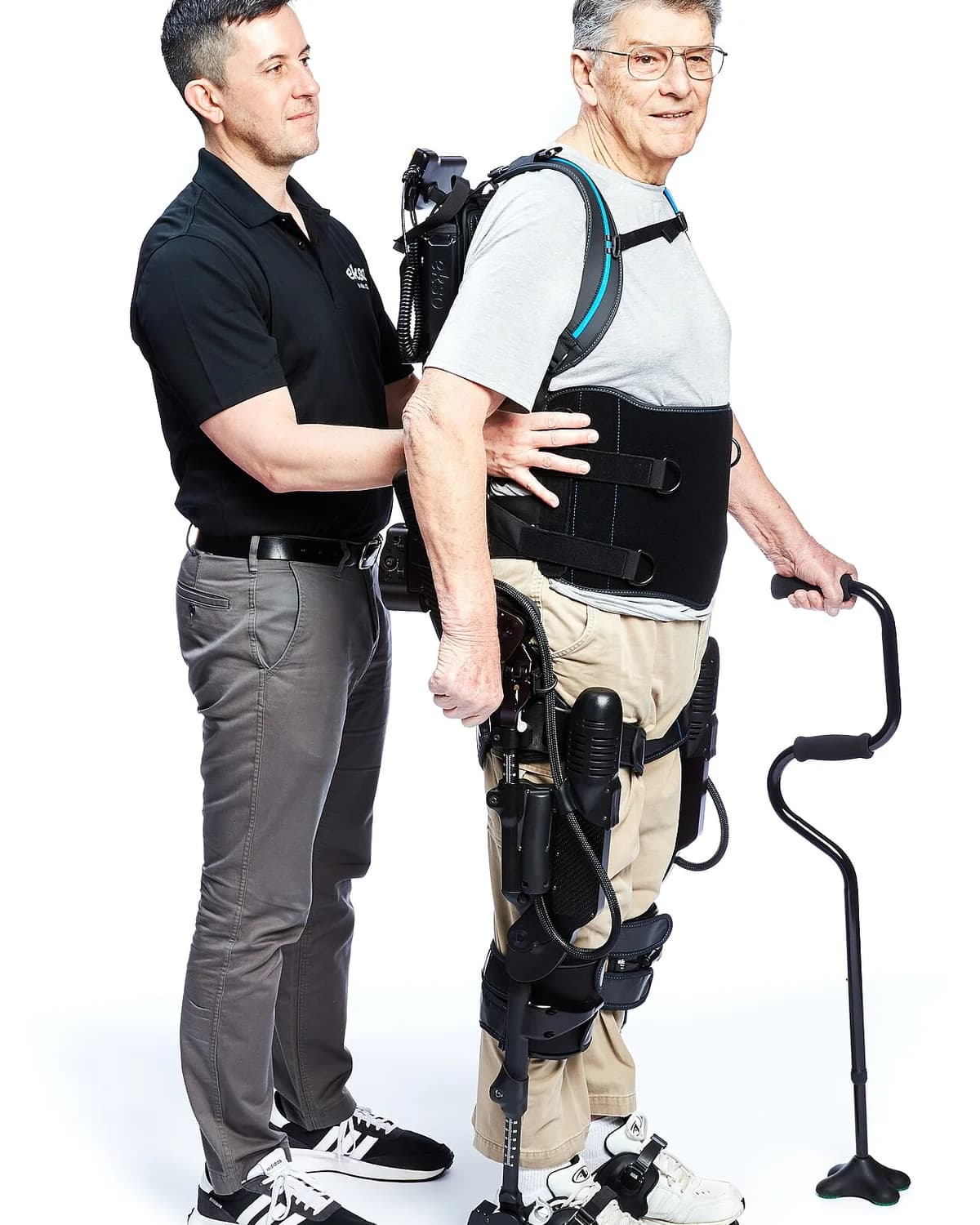
Knee osteoarthritis (OA) is a degenerative joint disease; the exoskeletons in this dataset are built for neurological gait impairment. EksoNR’s clinical evidence is described as “published stroke and spinal cord injury rehabilitation studies.” HAL Lower Limb cites “clinical studies in stroke, SCI and neuromuscular conditions.” Atalante X references “clinical studies in neurological rehabilitation.” Indego cites “peer-reviewed gait training studies,” and ExoMotus M4 cites “clinical rehabilitation studies in China.” None of these summaries mention osteoarthritis. A generic top-10 page might list these devices under “knee OA exoskeletons” without checking the label. That is the first gap: the indication is absent, and absence of evidence is not evidence of off-label safety.
What the datasheets actually disclose
The table below uses only supplied specifications. Where a parameter is missing, it is marked unknown or not disclosed—do not infer it from marketing material.
| System | Maker | Drive | Weight | Assist torque | Lift support | Speed | Certifications | Price |
|---|
| EksoNR | Ekso Bionics | Active | 23.6 kg | 40 Nm | Not applicable | 1.1 km/h | FDA, CE | Undisclosed |
| HAL Lower Limb | Cyberdyne | Hybrid | 17 kg | 40 Nm | Not applicable | 1.5 km/h | CE medical, ISO 13485 | Undisclosed |
| Atalante X | Wandercraft | Active | 65 kg | Unknown | 80 kg | 2.5 km/h | CE medical | Undisclosed |
| Indego | Parker Hannifin | Active | 12.3 kg | Unknown | Not applicable | 2 km/h | FDA, CE | Undisclosed |
| ExoMotus M4 | Fourier Intelligence | Active | 23.5 kg | Unknown | Not applicable | 1.2 km/h | NMPA, CE | Undisclosed |
Two devices disclose 40 Nm peak assist torque. Three do not. That single missing number matters more for OA than for stroke: knee OA involves load distribution across a damaged joint, and without torque data you cannot estimate whether the device unloads the knee or simply moves the leg. The database also marks peak assist force as undisclosed for every system. Without force and torque, a biomechanical assessment for OA is guesswork.
What the datasheet doesn't tell you
Peak assist force is undisclosed for all five systems. For a knee OA buyer, force at the joint is the parameter that determines whether an exoskeleton could reduce or increase articular load. No manufacturer in this dataset publishes it. You cannot compare systems on this axis, and you cannot claim load reduction.
Peak assist torque is unknown for Atalante X, Indego and ExoMotus M4. EksoNR and HAL disclose 40 Nm. The other three leave a blank. A procurement team comparing knee-assist capability has a two-system subset and three unknowns—not a shortlist.
Indicative price is undisclosed for every system. Price notes say “quoted by the maker,” “treatment or lease programme,” “capital purchase and service programme,” “regional reimbursement and configuration,” and “regional distributor pricing.” None of these are numbers. Total cost of ownership for an OA programme—including therapist time, service contracts and training—cannot be modelled from the database. That is a gap, not a negotiating tactic.
Clinical evidence does not name osteoarthritis. The evidence summaries list stroke, SCI, neuromuscular conditions and neurological rehabilitation. A buyer who needs OA-specific evidence will not find it here. Absence of a named study is not proof of harm, but it is proof of unverified benefit.
Deployment constraints the brochures skip
Atalante X weighs 65 kg. That is not a device a single therapist moves between rooms without planning. EksoNR is 23.6 kg, HAL 17 kg, Indego 12.3 kg and ExoMotus M4 23.5 kg. If your clinic has thresholds, lifts or shared treatment rooms, the weight difference between Indego and Atalante X changes the deployment model, not just the spec sheet. The database also shows height ranges: EksoNR 152–193 cm, HAL 145–190 cm, Atalante X 145–190 cm, Indego 155–195 cm, ExoMotus M4 155–190 cm. A patient outside those ranges is excluded regardless of diagnosis. For knee OA, where patient age and body habitus vary widely, the user weight limit matters too: EksoNR 100 kg, HAL 100 kg, Atalante X 100 kg, Indego 113 kg, ExoMotus M4 100 kg. Only Indego exceeds 100 kg in this dataset.
Certification and regional compliance differences
EksoNR and Indego carry FDA and CE. HAL Lower Limb carries CE medical and ISO 13485. Atalante X carries CE medical. ExoMotus M4 carries NMPA and CE. If you are procuring in North America, the FDA-cleared options in this dataset are EksoNR and Indego. In Europe, all five list CE. In Asia-Pacific, HAL and ExoMotus M4 list regional availability, while EksoNR lists Asia-Pacific and Atalante X lists Europe and North America. A generic page would say “CE marked” and stop. The procurement question is whether the specific configuration you are buying is covered by that mark for your indication—and for knee OA, it is not.
Who should not choose this
Do not choose any of these systems if your primary goal is knee osteoarthritis rehabilitation or pain reduction. The labelled indication is neurological gait training, the clinical evidence does not name OA, and the two most relevant biomechanical parameters—peak assist force and, for three systems, peak assist torque—are undisclosed or unknown. A clinic that buys an EksoNR or Indego for an OA programme is buying an unverified off-label use with no published force data to support a load-reduction claim. If you need a knee-focused device, this dataset does not contain one. If you are a researcher studying OA, you need a protocol and ethics approval before procurement, not a purchase order.
When an exoskeleton might still be relevant
If the patient has a neurological gait disorder and knee OA as a comorbidity, the calculation changes. You are then treating the neurological indication and managing the OA as a risk. In that case, Indego’s 113 kg user weight and 12.3 kg device weight make it the most portable option in the dataset, while EksoNR and HAL disclose 40 Nm assist torque—the only torque figures available. Atalante X offers 80 kg lift support and 12 degrees of freedom, but at 65 kg it is a fixed-site device. These are trade-offs between documented specs, not endorsements for OA.
FAQ
Is any exoskeleton approved for knee osteoarthritis?
Not in this database. EksoNR, HAL Lower Limb, Atalante X, Indego and ExoMotus M4 list neurological rehabilitation indications. None lists knee osteoarthritis.
Which system discloses assist torque for knee support?
EksoNR and HAL Lower Limb disclose 40 Nm peak assist torque. Atalante X, Indego and ExoMotus M4 mark it unknown. Peak assist force is undisclosed for all five.
Can I compare prices for knee OA exoskeletons?
No. Indicative price is undisclosed for every system in the dataset. Price notes refer to quotes, lease programmes or regional reimbursement, but no numeric price is supplied.
Next step
If you are evaluating a neurological gait system with an OA comorbidity, start by comparing EksoNR and Indego on the comparison page, then request the undisclosed peak assist force figure from the maker before any trial. For a broader view of medical systems, see the medical exoskeleton category. If you need a documented parameter that is missing here, contact the ExoSelect selection desk.
Sources: Ekso Bionics official product page (https://eksobionics.com/eksonr/); Cyberdyne official product page (https://www.cyberdyne.jp/english/products/LowerLimb_medical.html); Wandercraft official product page (https://www.wandercraft.eu/atalante-x); Parker Hannifin official product page (https://www.parker.com/us/en/industries/medical/indego.html); Fourier Intelligence official site (https://www.fourierintelligence.com). All specifications are from the ExoSelect DATABASE JSON.
 ExoSelect research