Quick answer
No exoskeleton in this dataset is a patient-handling or lifting device. EksoNR, HAL Lower Limb, Atalante X, Indego and ExoMotus M4 are therapist-supervised gait-training systems, and four of the five list rated lift support as not applicable. If your procurement goal is moving a dependent patient from bed to chair, buy a ceiling or floor hoist; if the goal is repetitive overground gait therapy, the exoskeleton question is a different one.
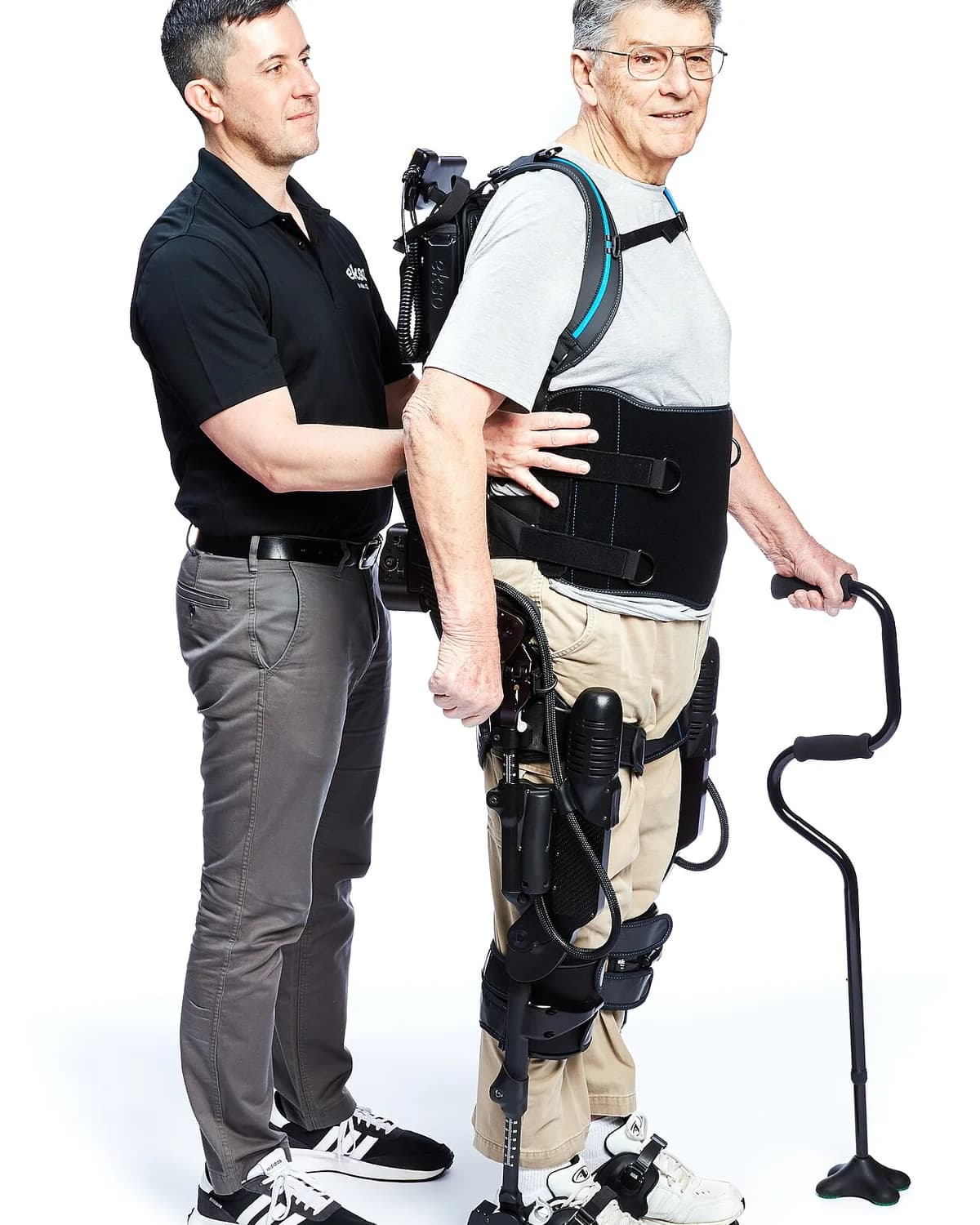
The term "patient handling" covers two jobs that buyers routinely conflate: transferring a non-weight-bearing body, and retraining a walking pattern. Only the second is in scope for the systems below. Ekso Bionics describes EksoNR as a therapist-supervised gait exoskeleton for inpatient and outpatient neurorehabilitation, and that framing holds across the category.
Key takeaways
- Four of five systems list rated lift support as not applicable; Atalante X is the only one with a documented figure (80 kg), and that is a balance-frame characteristic, not a transfer rating.
- Peak assist force is undisclosed for every system in the dataset. Peak assist torque is disclosed only for EksoNR (40 Nm) and HAL Lower Limb (40 Nm).
- Indego is the lightest at 12.3 kg and carries the highest documented user weight at 113 kg; Atalante X is the heaviest at 65 kg.
- Certification sets differ: FDA plus CE for EksoNR and Indego, CE medical only for Atalante X and HAL Lower Limb, NMPA plus CE for ExoMotus M4.
- No indicative price is disclosed for any system. Budget from a quote, not from a list price.
The five systems, on documented specs only
The table below uses only figures present in the ExoSelect database. Blank cells mean the maker has not disclosed the parameter, not that the parameter is unimportant.
| System | Maker | Drive | Weight | User weight | Speed | DoF | Battery | Certifications |
|---|
| EksoNR | Ekso Bionics | Active | 23.6 kg | 100 kg | 1.1 km/h | 4 | 4 h, swappable | FDA, CE |
| HAL Lower Limb | Cyberdyne | Hybrid | 17 kg | 100 kg | 1.5 km/h | 2 | 3 h, swappable | CE medical, ISO 13485 |
| Atalante X | Wandercraft | Active | 65 kg | 100 kg | 2.5 km/h | 12 | 4 h, swappable | CE medical |
| Indego | Parker Hannifin | Active | 12.3 kg | 113 kg | 2 km/h | 4 | 4 h, swappable | FDA, CE |
| ExoMotus M4 | Fourier Intelligence | Active | 23.5 kg | 100 kg | 1.2 km/h | 4 | 3 h, swappable | NMPA, CE |
Two figures deserve a second look. Atalante X documents 12 degrees of freedom against 2 for HAL Lower Limb and 4 for the rest; that is a design philosophy difference, not a quality ranking. And every system caps user weight at 100 kg except Indego at 113 kg, which matters if your ward population skews heavier.
Where the handling claim breaks down
A patient-handling device is judged on one number: how much of a dependent body it can hold and move. The dataset answers that question for exactly one system. Atalante X lists lift support of 80 kg; EksoNR, HAL Lower Limb, Indego and ExoMotus M4 list rated lift support as not applicable. That is not an omission by the makers — it reflects that these are gait-training devices worn by a patient who is assessed as suitable for standing and stepping, not hoists for a patient who is not.
Read the height ranges the same way. EksoNR covers 152–193 cm, Indego 155–195 cm, HAL Lower Limb and Atalante X 145–190 cm, ExoMotus M4 155–190 cm. A bariatric or very short patient may fall outside every frame in this set. Check the range against your actual case mix before you shortlist.
What the datasheet doesn't tell you
Peak assist force is undisclosed for all five systems. This is the single most consequential gap for a therapy buyer. Assist torque (40 Nm for EksoNR and HAL Lower Limb) tells you the rotational effort at a joint; assist force tells you what the device can actually deliver through the limb. Without it you cannot compare therapeutic intensity across systems, and you cannot match a device to a patient's impairment level on paper. Ask each maker for the figure in writing.
Peak assist torque is unknown for Atalante X, Indego and ExoMotus M4. For Atalante X this sits oddly beside its 12 degrees of freedom — a highly articulated system with no published torque figure is hard to position clinically. For Indego, a system marketed for both clinical gait training and personal mobility, the absence of a torque figure leaves the mobility claim unquantified.
No indicative price is disclosed for any system. EksoNR, HAL Lower Limb, Atalante X, Indego and ExoMotus M4 all return no price. The price notes are equally soft: EksoNR is quoted by the maker for clinical configuration, training and service; HAL Lower Limb is often offered as a treatment or lease programme rather than a capital purchase; Indego's final price depends on regional reimbursement and configuration. A lease or treatment-programme model changes the total-cost calculation entirely — you are buying sessions, not an asset — and no page in this dataset quantifies either model.
Lead times are vague where it matters. EksoNR states 8–12 weeks. Atalante X says "contact maker"; Indego and ExoMotus M4 say "contact regional distributor"; HAL Lower Limb is programme-dependent. If you are equipping a ward against a fixed opening date, only one system in this set gives you a number.
Regional compliance is not interchangeable
Certification sets split three ways. EksoNR and Indego carry FDA and CE. Atalante X and HAL Lower Limb carry CE medical only. ExoMotus M4 carries NMPA and CE. For a US procurement, that narrows the field to two systems on documented certification alone. For a European tender, all five are CE-marked, but only HAL Lower Limb also lists ISO 13485, and only Atalante X lists ISO 13482 alongside IEC 60601-1. Standards coverage also varies: EksoNR lists IEC 60601-1 and IEC 60601-1-2 (electromagnetic compatibility), while Indego and ExoMotus M4 list IEC 60601-1 only. If your biomedical engineering team requires an EMC statement, ask for it explicitly.
Regional availability compounds this. HAL Lower Limb is listed for Japan, Europe and Asia-Pacific — not North America. ExoMotus M4 covers Asia-Pacific, Europe and the Middle East. EksoNR and Atalante X both reach North America and Europe. A shortlist built on clinical fit alone can collapse at the availability check.
Battery and workflow: the numbers that shape a shift
Battery life runs 3 h (HAL Lower Limb, ExoMotus M4) to 4 h (EksoNR, Atalante X, Indego). All five have swappable batteries, which is the operationally important detail — a spare pack turns a 3-hour device into a full-day device. Charge times differ: 2 h for HAL Lower Limb and ExoMotus M4, 2.5 h for EksoNR and Indego, 3 h for Atalante X. If you run two sessions per patient per day, the swap-and-charge cycle, not the headline battery life, determines throughput.
Weight matters for a different reason. Indego at 12.3 kg and HAL Lower Limb at 17 kg are in a different handling class from Atalante X at 65 kg. A 65 kg self-balancing frame needs floor space, a transfer route and probably a dedicated room; a 12.3 kg modular device is moved by staff. Neither is a patient-handling aid, but one is far easier to deploy in a crowded rehabilitation gym.
Who should not choose this
Do not buy any system in this dataset if your core problem is staff injury from manual patient transfers. A gait exoskeleton does not lift a dependent patient, and four of the five explicitly list rated lift support as not applicable. The correct purchase is a hoist or a sit-to-stand aid, and no exoskeleton quote will substitute for it.
Do not choose Atalante X if floor space and room-to-room movement are constrained, given its 65 kg frame. Do not choose HAL Lower Limb for a North American site — it is not listed for that region. Do not choose EksoNR or Indego for a European tender that requires ISO 13485 evidence, since neither lists it. And do not commit to any of the five before you have a written peak assist force figure; without it you are comparing therapeutic capability on marketing language.
How to run the comparison
Start from the medical exoskeleton category and filter by certification and region first, because those eliminate systems fastest. Then pull the side-by-side comparison for your two finalists and check the unknowns column before you read the specs. If you need a documented parameter that is missing here, the selection desk can request it from the maker on your behalf.
FAQ
Can an exoskeleton be used to lift or transfer a patient?
Not the systems in this dataset. EksoNR, HAL Lower Limb, Indego and ExoMotus M4 list rated lift support as not applicable; Atalante X lists 80 kg lift support as part of its self-balancing frame, which is not a transfer rating. Use a hoist for transfers.
Which system has the highest documented user weight?
Indego, at 113 kg. EksoNR, HAL Lower Limb, Atalante X and ExoMotus M4 all document 100 kg.
Is pricing available for any of these systems?
No. Indicative price is undisclosed for all five. EksoNR, Atalante X and ExoMotus M4 are quoted by the maker or regional distributor; HAL Lower Limb is often offered as a lease or treatment programme; Indego pricing depends on regional reimbursement and configuration.
One next step
Request the written peak assist force figure from Ekso Bionics for EksoNR and from Cyberdyne for HAL Lower Limb, then compare those two against your patient case mix using the ExoSelect comparison tool. If neither maker will disclose it, treat that as a procurement signal in itself.
 ExoSelect research