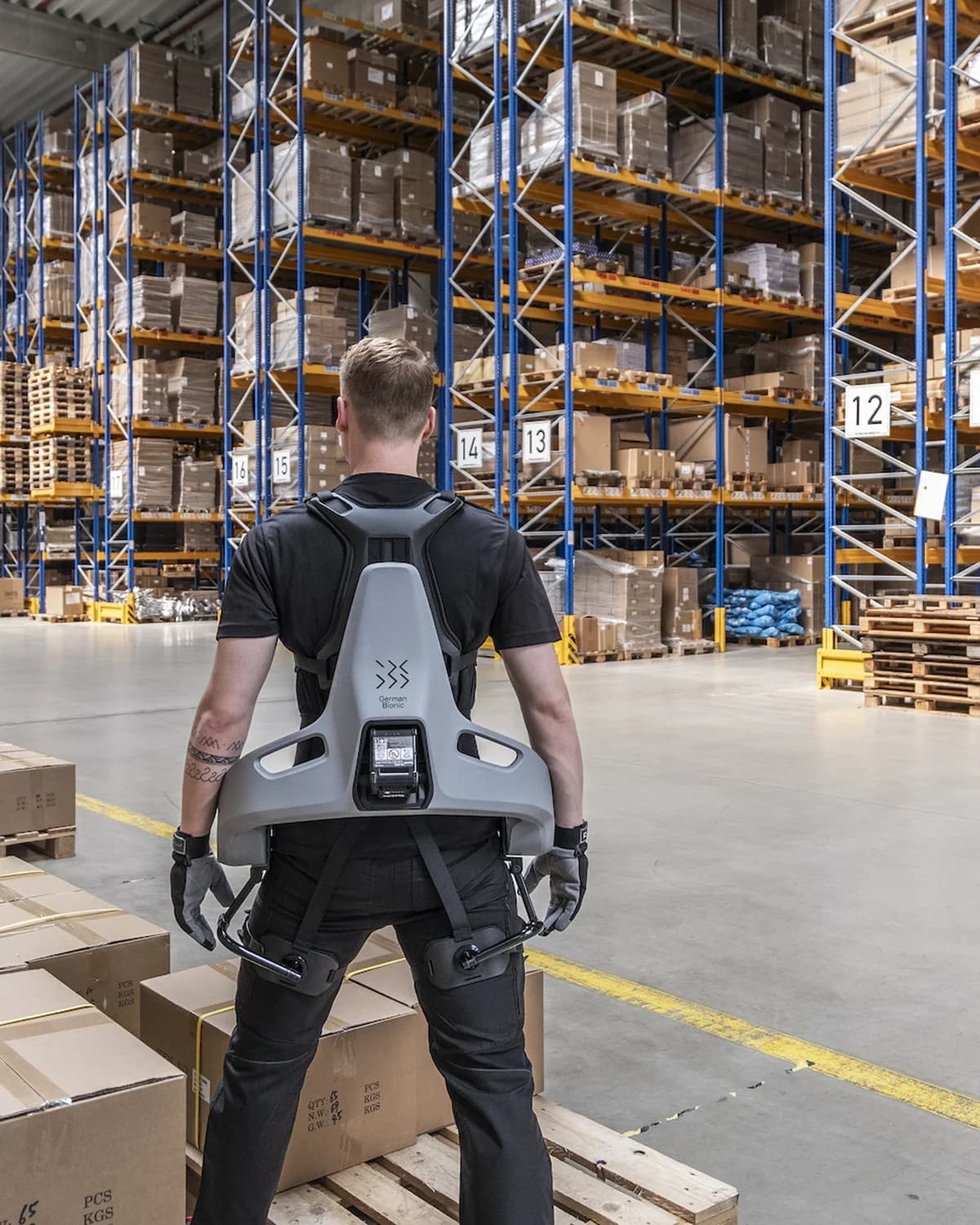
Quick answer: The Cray X is an active, connected back exoskeleton from German Bionic for lifting, carrying and forward-bending tasks. It delivers up to 300 N of assist force and 30 Nm of torque, weighs 7.6 kg, and lists from 9,900 USD, with a 6–10 week lead time in Europe and North America.
The Cray X is a powered back exoskeleton from German Bionic, designed to support industrial lifting and forward-bending. It is one of the few active systems in the industrial category, and its specifications place it at the premium end of the market. This spotlight examines the documented parameters, identifies what the datasheet leaves out, and provides a clear procurement stance for engineering and purchasing teams.
Key takeaways
- Active assistance with 300 N force and 30 Nm torque, targeting lifting and sit-to-stand support.
- 7.6 kg system weight, two adjustable frame sizes covering 160–195 cm height and up to 110 kg user weight.
- Hot-swappable lithium-ion battery with 8 h runtime and 2 h charge time.
- CE marked and compliant with ISO 13482 and EN 614-1; connectivity via Cray Visor app and cloud dashboard.
- Indicative price from 9,900 USD; lead time 6–10 weeks; available in Europe and North America.
- Warranty terms are undisclosed in the database; buyers must request them.
What the Cray X is and who makes it
German Bionic, a German manufacturer, produces the Cray X as part of its connected exoskeleton line. The system is active, meaning it uses powered actuators to assist the wearer, rather than passive springs or elastic bands. It is intended for tasks that involve repetitive lifting, carrying, and forward bending, such as logistics, manufacturing, and construction. The Cray X is available in Europe and North America, with a lead time of 6–10 weeks.
Specifications that matter for selection
The Cray X’s assist force of 300 N and torque of 30 Nm are among the highest in the industrial back-assist segment. For context, passive exosuits like the Apex 2 provide 220 N and 22 Nm, while passive shoulder devices like the Skelex 360 offer 70 N and 12 Nm. The active drive allows the Cray X to adapt assistance to the task, with control modes for adaptive lift assistance and sit-to-stand support. The system weighs 7.6 kg, which is substantial for a wearable device, and uses carbon fibre and aluminium in its frame. Two frame sizes accommodate users from 160 to 195 cm and up to 110 kg. The hot-swappable battery provides 8 hours of runtime and charges in 2 hours, enabling continuous operation across shifts. Connectivity includes the Cray Visor app, a cloud fleet dashboard, and Bluetooth, which supports usage telemetry and fleet management.
Comparison with other industrial exoskeletons
The table below compares the Cray X with three other systems in the database on key documented parameters. Only supplied specifications are shown; missing data is marked as not disclosed or not applicable.
| Parameter | Cray X (German Bionic) | Apex 2 (HeroWear) | Skelex 360 (Skelex) | MATE-XT (Comau) |
|---|
| Drive | Active | Passive | Passive | Passive |
| Weight | 7.6 kg | 1.2 kg | 1.6 kg | 4.2 kg |
| Assist force | 300 N | 220 N | 70 N | 100 N |
| Assist torque | 30 Nm | 22 Nm | 12 Nm | 15 Nm |
| Lift support | 30 kg | 20 kg | 5 kg | 5 kg |
| Price (from) | 9,900 USD | 1,195 USD | 4,900 USD | 5,900 USD |
| Battery runtime | 8 h | Not applicable | Not applicable | Not applicable |
| Connectivity | Cray Visor app, cloud, Bluetooth | None | None | None |
| Certifications | CE, ISO 13482 | CE | CE | CE, ISO 13482 |
| Warranty | Undisclosed | 12 months | 24 months | Undisclosed |
The Cray X stands out for its active assistance and connectivity, but it is also the heaviest and most expensive system in this comparison. The Apex 2 is a lightweight passive exosuit at a fraction of the cost, while the Skelex 360 and MATE-XT are passive shoulder supports with lower assist forces. Buyers should weigh the benefits of active, data-driven assistance against the higher weight, price, and operational complexity.
What the datasheet doesn't tell you
Several parameters critical to deployment are missing from the database. The warranty is undisclosed, which means buyers cannot assess long-term service costs or protection against actuator or battery failure. For an active system with a 7.6 kg frame and hot-swappable batteries, warranty terms directly affect total cost of ownership. Additionally, the database does not provide a maximum walking speed or stair/slope capability; these are marked not applicable, but in practice, users may need to navigate stairs or ramps, and the absence of documented limits could pose safety or productivity risks. Clinical evidence is also not applicable, which is expected for an industrial device, but buyers should not assume any ergonomic or injury-reduction claims are validated by independent studies. Finally, the database does not list operating temperature, ingress protection (IP rating), or noise levels—parameters that matter in harsh industrial environments. These gaps must be closed through a formal request to German Bionic.
Who should not choose this
The Cray X is not the right choice for organisations with tight budgets or for tasks that require extreme mobility. At 9,900 USD per unit, it is eight times the price of the Apex 2, and the active system adds weight and complexity. If your primary need is shoulder support for overhead work, a passive device like the Skelex 360 or MATE-XT is more appropriate and far lighter. If you operate in environments where a 7.6 kg exoskeleton could be a snag hazard or cause fatigue—such as confined spaces or tasks requiring frequent climbing—the Cray X may be unsuitable. Also, if you require documented warranty terms before purchase, the undisclosed warranty is a red flag; consider the Skelex 360, which offers a 24-month warranty, or the Apex 2 with 12 months. Finally, if your operations are outside Europe or North America, the Cray X is not listed as available, so you would need to explore regional alternatives.
Procurement and deployment notes
For buyers in Europe or North America, the Cray X offers a 6–10 week lead time, which is longer than the Apex 2 (2–4 weeks) but comparable to the MATE-XT (4–8 weeks). The hot-swappable battery and 2-hour charge time support multi-shift operations, but you will need to budget for spare batteries and charging infrastructure. The connectivity features enable fleet management and usage telemetry, which can help justify ROI, but they also require IT integration and data governance. Training is essential for active systems, and German Bionic likely provides onboarding—confirm this in the quote. The price is indicative; fleet pricing and service contracts are negotiable, so request a detailed proposal that includes warranty, service levels, and spare parts.
FAQ
What is the warranty on the Cray X?
The warranty is not disclosed in the database. Buyers must request warranty terms directly from German Bionic.
Can the Cray X be used on stairs or slopes?
The database marks stair/slope capability as not applicable, meaning no specification is provided. Users should avoid such terrain unless German Bionic confirms otherwise.
Is the Cray X certified for use in the EU?
Yes, it carries CE marking and is listed as compliant with ISO 13482 and EN 614-1, which are relevant for machinery and personal care robots.
For a direct comparison with passive alternatives, see our comparison tool. To request a formal quote or discuss fleet pricing, contact the ExoSelect selection desk. You can also review the Cray X product page and the Apex 2 for a lighter, lower-cost option.
 ExoSelect research