Quick answer: For overhead and precision work, a passive shoulder exoskeleton is the default choice; the documented options in this dataset are Skelex 360 (Skelex), MATE-XT (Comau) and AIRFRAME (Levitate Technologies). Buyers should compare assist force, weight, height range and certification, and treat undisclosed warranty and standards as procurement risks rather than assuming parity.
If your task is sustained arm elevation, the answer is a passive shoulder exoskeleton, not a powered back system. The three systems with shoulder-assist intent in this dataset are Skelex 360, MATE-XT and AIRFRAME; Cray X and Apex 2 are back or hip-assist devices and should not be shortlisted for shoulder support on the basis of their marketing category.
Key takeaways
- Passive shoulder systems differ most on assist force and weight: Skelex 360 offers 70 N at 1.6 kg, MATE-XT 100 N at 4.2 kg, AIRFRAME 60 N at 1.5 kg.
- All three are CE-marked; Skelex 360 and MATE-XT also cite ISO 13482, while AIRFRAME's referenced standards are unknown in this dataset.
- Warranty is disclosed only for Skelex 360 (24 months); MATE-XT and AIRFRAME do not disclose warranty terms.
- Price from is indicative: Skelex 360 at 4,900 USD, MATE-XT at 5,900 USD, AIRFRAME at 2,950 USD.
- None of the three shoulder systems provides connectivity or sensor data; fleet-level usage telemetry is not available on these units.
What “shoulder assist” means in this dataset
Shoulder assist here means a passive upper-limb exoskeleton that supports the arm during elevation, typically for overhead assembly, inspection or precision tasks. The dataset contains three such systems: Skelex 360 from Skelex, MATE-XT from Comau and AIRFRAME from Levitate Technologies. All are passive, with no battery, no sensors and no connectivity. The two other industrial systems in the dataset, Cray X (German Bionic) and Apex 2 (HeroWear), are back and hip-assist devices respectively; they are not shoulder-assist products and should not be compared as such.
Comparison table: documented shoulder-assist specs
| Spec | Skelex 360 | MATE-XT | AIRFRAME |
|---|
| Maker | Skelex | Comau | Levitate Technologies |
| Drive | Passive | Passive | Passive |
| Weight | 1.6 kg | 4.2 kg | 1.5 kg |
| Assist force | 70 N | 100 N | 60 N |
| Assist torque | 12 Nm | 15 Nm | 10 Nm |
| Height range | 160–195 cm | 155–195 cm | 157–198 cm |
| User weight | 110 kg | 100 kg | 113 kg |
| Sizes | Adjustable | Adjustable, one size | Adjustable |
| Lift support | 5 kg | 5 kg | 5 kg |
| Certifications | CE | CE, ISO 13482 | CE |
| Standards | ISO 13482 | ISO 13482 | Unknown |
| Warranty | 24 months | Undisclosed | Unknown |
| Price from | 4,900 USD | 5,900 USD | 2,950 USD |
| Lead time | Contact maker | 4–8 weeks | Contact maker |
| Regions | Europe, North America | Europe, North America, Asia-Pacific | North America |
How to read the trade-offs
The table shows a clear trade-off between assist force and weight. MATE-XT delivers the highest documented assist force (100 N) and torque (15 Nm) but weighs 4.2 kg, more than twice the weight of Skelex 360 (1.6 kg) and nearly three times AIRFRAME (1.5 kg). For tasks where the exoskeleton is worn continuously through a shift, weight matters for fatigue and compliance; for tasks requiring maximum lift support, assist force matters. Skelex 360 sits between the two at 70 N and 1.6 kg. AIRFRAME is the lightest and lowest-force option at 60 N and 1.5 kg. None of these numbers is a substitute for a task-specific assessment, but they are the only documented points of comparison in this dataset.
Height range is another differentiator. AIRFRAME covers 157–198 cm, MATE-XT 155–195 cm and Skelex 360 160–195 cm. If your workforce includes operators below 160 cm, Skelex 360 is outside that range; if above 195 cm, MATE-XT and Skelex 360 are outside. User weight limits also differ: AIRFRAME 113 kg, Skelex 360 110 kg, MATE-XT 100 kg. These are hard constraints, not preferences.
What the datasheet doesn't tell you
Warranty for MATE-XT and AIRFRAME. The dataset records warranty as undisclosed for MATE-XT and unknown for AIRFRAME. Warranty is a direct cost-of-ownership variable: a 24-month warranty (Skelex 360) versus an undisclosed term changes the three-year maintenance budget. Buyers should request the warranty document before comparing total cost.
Standards for AIRFRAME. AIRFRAME is CE-marked, but the dataset does not identify which standards are referenced (state: unknown). CE marking alone does not confirm conformity to ISO 13482; if your procurement requires that standard, AIRFRAME's compliance cannot be verified from this dataset.
Clinical evidence. For Skelex 360 and AIRFRAME, clinical evidence is recorded as unknown. MATE-XT records clinical evidence as not applicable. Absence of clinical evidence is not evidence of absence, but buyers should not assume published trials exist for any of these systems without requesting them.
Lead time and availability. Skelex 360 and AIRFRAME list lead time as “Contact maker” and availability as “Available on inquiry”; MATE-XT lists 4–8 weeks and “Available”. For pilot planning, only MATE-XT gives a documented lead time in this dataset.
Who should not choose this
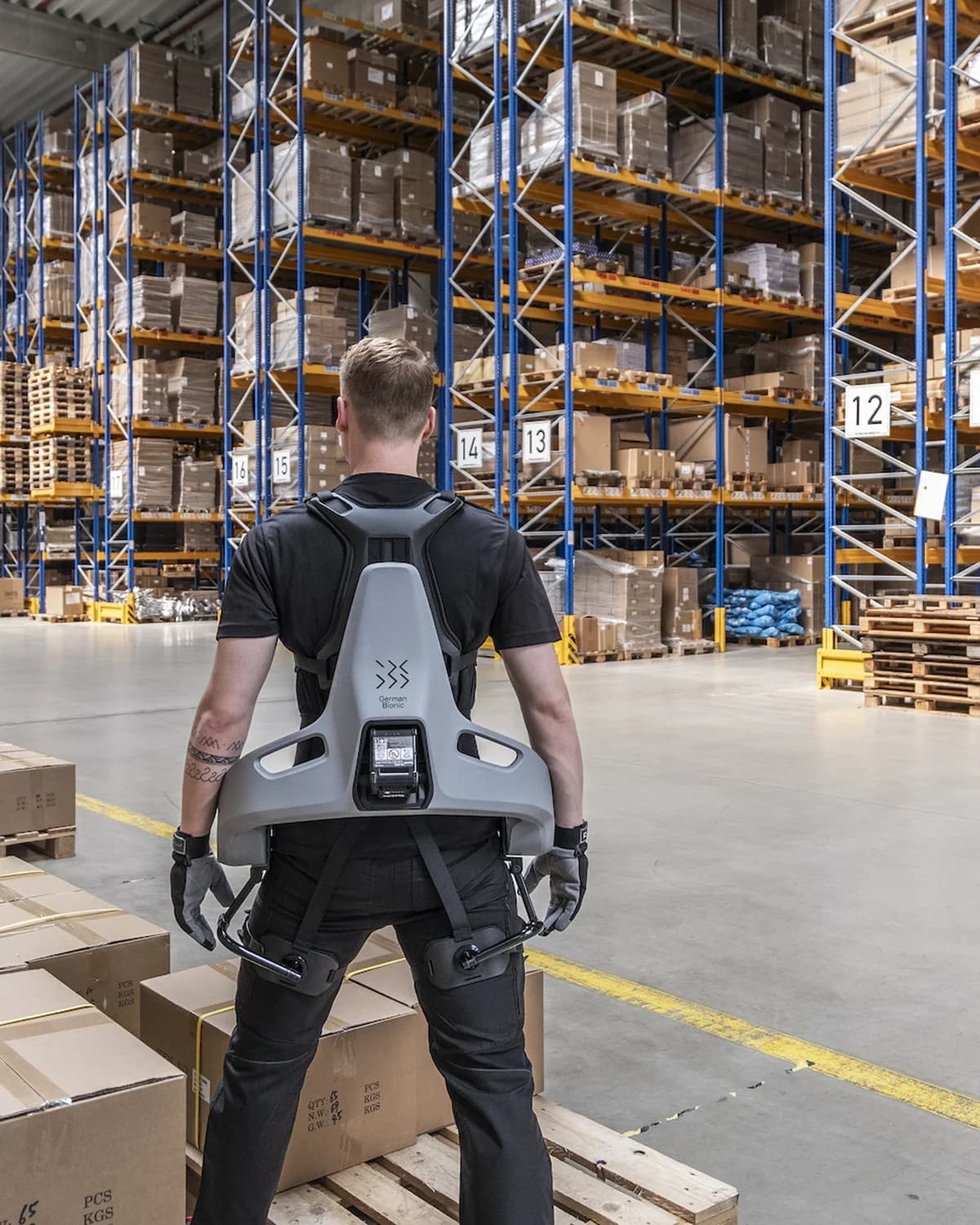
Do not choose a passive shoulder exoskeleton if your task is primarily lifting from the floor or forward bending; that is back-assist territory, and the shoulder systems here are not designed for it. Do not choose MATE-XT if operator weight exceeds 100 kg or if continuous wear weight is a primary concern, because its 4.2 kg mass and 100 kg user limit are the most restrictive in the group. Do not choose Skelex 360 if your workforce includes operators shorter than 160 cm, as its height range starts at 160 cm. Do not choose AIRFRAME if your procurement requires a documented ISO 13482 reference or a disclosed warranty, because neither is available in this dataset. And do not choose any of these if you need usage telemetry or fleet connectivity: none of the three shoulder systems offers sensors or connectivity, unlike the powered Cray X back exoskeleton.
Procurement next step
Before issuing an RFQ, request the missing documents: warranty terms for MATE-XT and AIRFRAME, the standards list for AIRFRAME, and any clinical or field evidence for Skelex 360 and AIRFRAME. Use the compare tool to place Skelex 360, MATE-XT and AIRFRAME side by side, and check the industrial category page for additional systems as they are added. If you need a documented parameter that is not in the dataset, contact the selection desk with the specific parameter and we will request it from the maker.
FAQ
Which shoulder exoskeleton is lightest?
AIRFRAME is the lightest at 1.5 kg, followed by Skelex 360 at 1.6 kg and MATE-XT at 4.2 kg.
Do these shoulder exoskeletons have batteries?
No. All three are passive systems; battery chemistry, runtime and charge time are not applicable in this dataset.
Is ISO 13482 certification documented for all three?
No. Skelex 360 and MATE-XT reference ISO 13482; AIRFRAME's referenced standards are unknown in this dataset, although it is CE-marked.
Sources: manufacturer product pages for Skelex, Comau MATE-XT and Levitate Technologies. All specifications are from the ExoSelect database as of the date of this guide.
 ExoSelect research