Quick answer
For clinical gait training, the five documented systems split by drive and deployment model: EksoNR (Ekso Bionics), Indego (Parker Hannifin) and ExoMotus M4 (Fourier Intelligence) are therapist-supervised active trainers with 4 degrees of freedom, while HAL Lower Limb (Cyberdyne) uses bioelectric signal control on 2 DOF and Atalante X (Wandercraft) is a 12-DOF self-balancing frame with 80 kg lift support. None of the five discloses an indicative price or peak assist force, so any comparison that ranks them by cost or assistance output is working from assumptions, not data.
Key takeaways
- Indego is the lightest documented system at 12.3 kg and carries the highest stated user weight at 113 kg; EksoNR is 23.6 kg at 100 kg.
- Atalante X is the only system in this set with a published lift support figure (80 kg) and the only one with 12 DOF.
- HAL Lower Limb is typically a lease or treatment programme, not a capital purchase — a different budget line from the others.
- Certification coverage differs: EksoNR and Indego hold FDA plus CE; Atalante X holds CE medical; ExoMotus M4 holds NMPA plus CE.
- Peak assist force is undisclosed for all five systems, and peak assist torque is unknown for three of them.
The comparison table, built only from disclosed specs
| Spec | EksoNR | HAL Lower Limb | Atalante X | Indego | ExoMotus M4 |
|---|
| Maker | Ekso Bionics | Cyberdyne | Wandercraft | Parker Hannifin | Fourier Intelligence |
| Drive | Active | Hybrid | Active | Active | Active |
| Weight | 23.6 kg | 17 kg | 65 kg | 12.3 kg | 23.5 kg |
| User weight | 100 kg | 100 kg | 100 kg | 113 kg | 100 kg |
| Height range | 152–193 cm | 145–190 cm | 145–190 cm | 155–195 cm | 155–190 cm |
| Speed | 1.1 km/h | 1.5 km/h | 2.5 km/h | 2 km/h | 1.2 km/h |
| DOF | 4 | 2 | 12 | 4 | 4 |
| Assist torque | 40 Nm | 40 Nm | Unknown | Unknown | Unknown |
| Lift support | Not applicable | Not applicable | 80 kg | Not applicable | Not applicable |
| Battery life | 4 h | 3 h | 4 h | 4 h | 3 h |
| Charge time | 2.5 h | 2 h | 3 h | 2.5 h | 2 h |
| Certifications | FDA, CE | CE medical, ISO 13485 | CE medical | FDA, CE | NMPA, CE |
| Availability | On inquiry | Lease or programme | On inquiry | On inquiry | On inquiry |
| Regions | NA, EU, APAC | Japan, EU, APAC | EU, NA | NA, EU | APAC, EU, ME |
Full spec sheets sit on each product page: EksoNR, HAL Lower Limb, Atalante X, Indego and ExoMotus M4. The medical category page lists the wider set.
What actually separates these systems for gait training
The table looks like a spec race, but three variables decide deployment. The first is control philosophy. HAL Lower Limb reads bioelectric signals and runs on 2 DOF; that is a fundamentally different training proposition from the 4-DOF therapist-adjusted assistance on EksoNR or the therapist-controlled gait on ExoMotus M4. A clinic choosing between them is choosing a rehabilitation method, not just a machine.
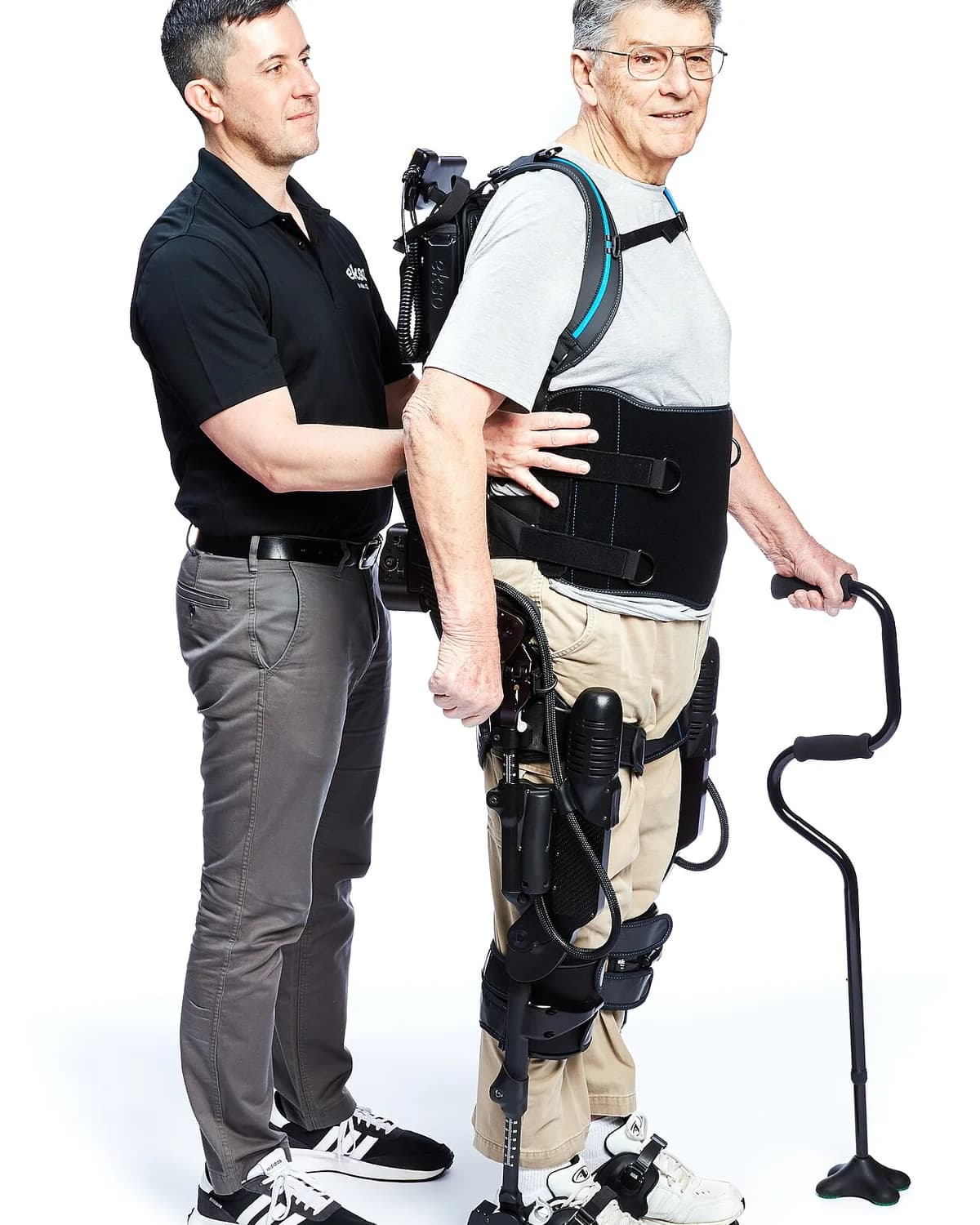
The second is physical footprint and handling. Atalante X weighs 65 kg — roughly five times Indego's 12.3 kg. Self-balancing architecture buys 12 DOF and 80 kg lift support, but it changes room layout, transfer routines and staff numbers. Indego's modular hip, thigh and shank sizing plus 113 kg user weight makes it the more forgiving fit across a mixed patient population, and its Bluetooth session logging is a documented data path.
The third is commercial model. Cyberdyne positions HAL Lower Limb as a treatment or lease programme, which moves the cost from capital equipment to operating expense and changes how a finance committee approves it. The other four are quoted on inquiry as capital purchases with service programmes. That is not a price comparison — no price is disclosed anywhere in this dataset — but it is a procurement-structure comparison, and it matters more than most spec rows.
Speed, torque and the numbers buyers over-read
Atalante X lists the highest speed at 2.5 km/h, followed by Indego at 2 km/h, HAL at 1.5 km/h, ExoMotus M4 at 1.2 km/h and EksoNR at 1.1 km/h. Treat these as ceiling figures for level-ground operation, because that is all the data supports. EksoNR and Atalante X both state that stair training is not supported; Indego and ExoMotus M4 require clinical assessment for stairs; HAL states level walking with clinical assessment required. No system in this set documents stair training as a supported function.
Assist torque is published for only two systems — EksoNR and HAL Lower Limb, both 40 Nm. For Atalante X, Indego and ExoMotus M4 the value is unknown. A buyer comparing assistance capability across all five has two data points and three blanks. That asymmetry should shape the tender document: ask for torque at the joint, not a marketing phrase.
Certification and regional compliance differences
Ekso Bionics and Parker Hannifin both document FDA and CE for EksoNR and Indego respectively, with IEC 60601-1 cited. Atalante X documents CE medical and cites IEC 60601-1 plus ISO 13482 — the personal care robot standard, which is a different conformity argument from a pure medical device claim. Cyberdyne lists CE medical and ISO 13485, a quality-management standard rather than a product safety standard. Fourier Intelligence lists NMPA and CE, reflecting its China-first clinical evidence base.
For a European NHS or private clinic, CE medical is the common denominator across all five. For a US buyer, only EksoNR and Indego document FDA in this dataset. That single row eliminates three systems from a US capital procurement before any clinical evaluation begins.
What the datasheet doesn't tell you
Peak assist force is undisclosed for all five systems. This is the parameter that most directly determines whether a patient with limited residual strength can be trained, and no maker in this set publishes it. A buyer cannot rank assistance output from these datasheets at all.
Peak assist torque is unknown for Atalante X, Indego and ExoMotus M4. Two of five systems publish 40 Nm. Without the other three, torque-based shortlisting is guesswork.
Indicative price is undisclosed for every system. Price notes confirm quoting models — clinical configuration and training for EksoNR, regional reimbursement for Indego, distributor pricing for ExoMotus M4, capital plus service for Atalante X — but no figure. Total cost of ownership, including therapist training, service contracts and battery replacement, cannot be modelled from this dataset.
Lead time is only firm for EksoNR at 8–12 weeks. HAL is programme-dependent; the other three say contact maker or regional distributor. For a clinic planning a rehabilitation programme start date, that is a scheduling risk.
Warranty is 12 months across all five. That uniformity is itself worth questioning in a tender — extended service terms are not documented here.
Who should not choose this
If your procurement requires a published price before shortlisting, do not run this comparison as a cost exercise — none of the five discloses one, and you will end up scoring vendors on sales responsiveness rather than product fit. Issue a structured request for quotation instead.
If you are a US clinical buyer needing FDA clearance, exclude HAL Lower Limb, Atalante X and ExoMotus M4 at the compliance gate; only EksoNR and Indego document FDA in this dataset. Do not let a strong clinical-evidence narrative override a missing clearance.
If your gait-training programme depends on stair negotiation, none of these five is documented as supporting it. Do not select any of them on the assumption that stair training is a configuration option.
If floor space and staff handling capacity are tight, Atalante X at 65 kg is the wrong first choice unless the 80 kg lift support and self-balancing function are the clinical reason for the purchase. Indego at 12.3 kg is the lighter documented alternative.
FAQ
Which medical exoskeleton is lightest for gait training?
Indego at 12.3 kg, per Parker Hannifin's documented specs. HAL Lower Limb is next at 17 kg; Atalante X is heaviest at 65 kg.
Do any of these systems publish a price?
No. Indicative price is undisclosed for all five. Each is quoted on inquiry, and HAL Lower Limb is typically offered as a lease or treatment programme.
Which systems are FDA cleared?
EksoNR (Ekso Bionics) and Indego (Parker Hannifin) document FDA alongside CE. Atalante X and HAL Lower Limb document CE medical; ExoMotus M4 documents NMPA and CE.
Next step
Before any demo, send each shortlisted maker one written request: peak assist force at the hip and knee, peak assist torque where marked unknown, and a full five-year service and training quote. Start with the side-by-side compare tool to lock the documented specs, then route the unanswered parameters through the selection desk. Official manufacturer documentation for each system is linked from its product page and should be the reference of record in your tender file.
 ExoSelect research